
Sustainability by their own standards: a strategy for SCHL

To safeguard the long-term value of its portfolio, the Société Coopérative d’Habitation Lausanne (SCHL) did not want to simply adopt an existing sustainability standard, but rather to define its own sustainability criteria. Together with Basler & Hofmann, the largest housing cooperative in French-speaking Switzerland has developed a customized strategy and a dashboard. These two management tools help the cooperative better prioritize its investments.
Switzerland’s building stock accounts for 22% of the country’s domestic CO₂ emissions.* Owners of larger real estate portfolios can therefore make a significant contribution to achieving Switzerland’s climate goals. But sustainability encompasses far more than just reduced CO₂ emissions. Tenants and investors also value aspects such as living comfort, biodiversity, and accessibility. In addition, housing should be affordable. Sustainability has become a key factor in attractiveness and an investment criterion.
Sustainability Criteria Guide Investments
Founded in 1920, SCHL employs about fifty people and manages approximately 2,500 apartments spread across more than 100 properties in the canton of Vaud. The cooperative pursues the following goals in particular: providing affordable housing, conducting necessary renovations, and improving living comfort. The challenge lies in prioritizing renovation measures in a way that preserves the value of the buildings, takes into account federal and cantonal climate goals, and improves living comfort for tenants.
An Independent Sustainability Strategy
SCHL had already conducted energy analyses and CO2 calculations. For future investment decisions, it wanted to take additional sustainability aspects into account. While multinational companies often base their strategies on established, internationally recognized labels, cooperatives tend to pursue their own individual sustainability goals. The impetus for the collaboration arose at an event organized by Basler & Hofmann in Lausanne on the Swiss Sustainable Building Standard (SNBS). There, representatives from SCHL spoke with Fabio Sicurella, an expert in sustainable building, about how the cooperative could define and implement its own sustainability criteria. This marked the start of the joint development of a sustainability strategy.
Strategic Objectives and Measurability
First, a SCHL project team held a workshop to explore the strategic direction within the broad field of sustainability. Participants included representatives from executive management, the Board of Directors’ office, project management, and the finance department. Fabio Sicurella and the project team from Basler & Hofmann facilitated the workshop and set out the framework for the discussion by providing information on legal requirements, national and international sustainability standards, and their own project experiences. Building on this foundation, SCHL worked with the consultants from Basler & Hofmann during the workshop to define sustainability criteria aligned with its overall strategy and portfolio. These include environmental criteria such as biodiversity, economic criteria such as rent levels, and social criteria such as tenant diversity. Based on these criteria, the sustainability team at Basler & Hofmann developed a dashboard. For each criterion, the project participants jointly determined how it would be measured and evaluated. This enables SCHL to assess where its buildings currently stand and identify areas where action is needed.
Field Test: Green Due Diligence for a Property
Basler & Hofmann tested whether the dashboard would prove effective in practice as part of a pilot project for SCHL. For a property in need of renovation, the team conducted a sustainability analysis (Green Due Diligence, GDD) based on five defined ecological sustainability criteria, in addition to a structural and technical condition assessment (Technical Due Diligence, TDD). To this end, our team compiled the real estate’s existing data, inspected the building, and prepared a thorough analysis of the current state. The team then evaluated three renovation options based on the sustainability criteria and prepared a cost estimate for each option. The GDD provided SCHL with the necessary foundation to improve the property’s sustainability as part of the redevelopment.

From Individual Properties to Portfolio Management
Next, our sustainability team showed SCHL how it could use the dashboard as a management tool for its entire portfolio. Together with SCHL, we identified eight buildings that are representative of the architectural eras and the existing structure of the entire property portfolio. The team subjected these eight buildings to a sustainability analysis based on SCHL’s criteria. Using the results, it determined a representative average value for the entire portfolio for each criterion—such as the building materials used or biodiversity. This provides the cooperative with an overview of the sustainability status of its building portfolio. At the same time, it now has a benchmark against which it can compare the status of each piece of real estate with its target vision for the entire portfolio.
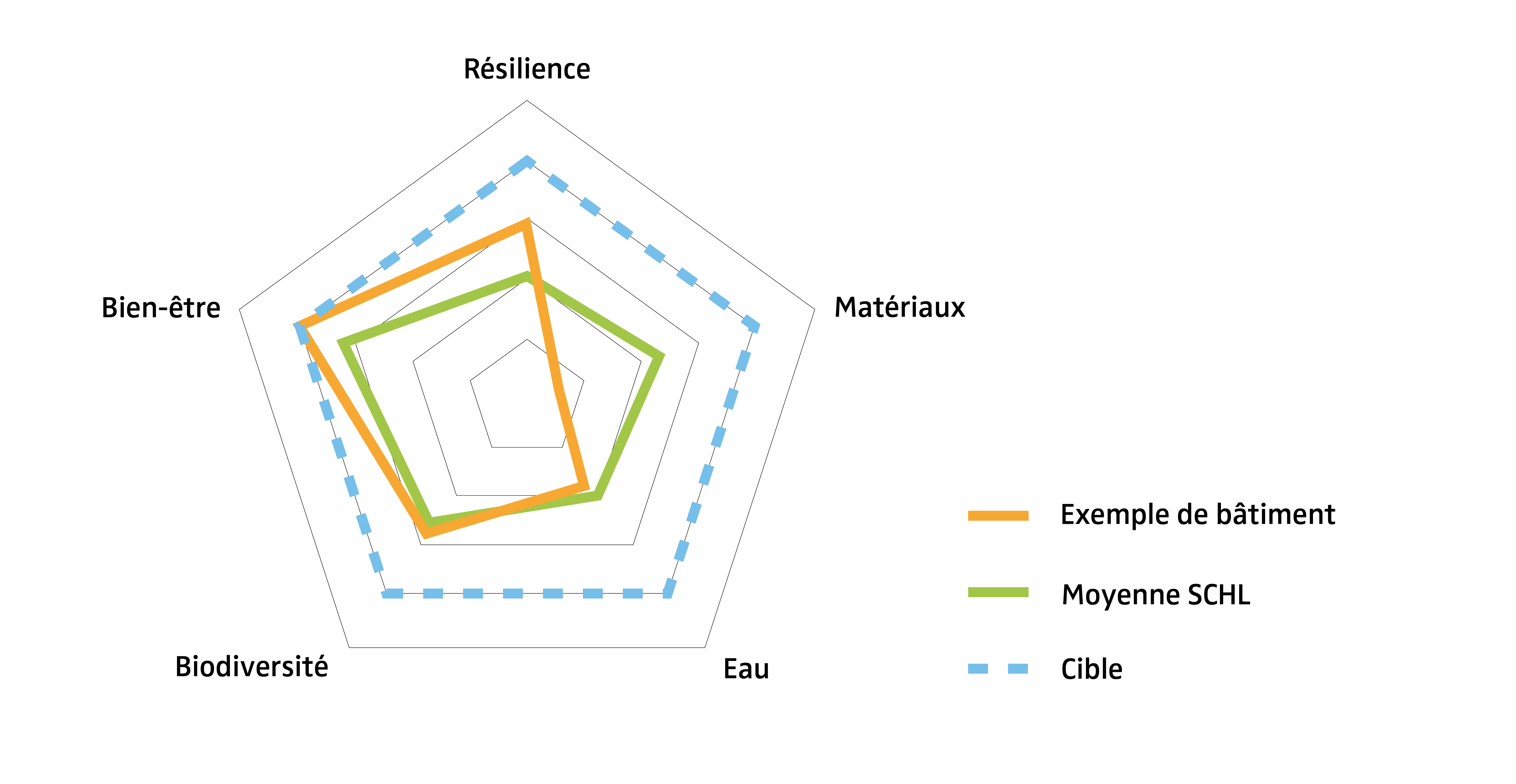
The work carried out in collaboration with Basler & Hofmann has helped SCHL firmly embed its sustainability strategy within its organization. Going forward, data on all properties will be collected and consolidated; in addition, employees will receive training on how to use the dashboard and apply the sustainability criteria. In this way, the sustainability criteria will be directly integrated into the planning and implementation of renovation projects.
* Swiss Federal Office of Energy: https://www.bfe.admin.ch/en/buildings, as of November 18, 2026