Planning, craftsmanship and AI: how the Hardau residential towers get their fresh face



Almost 30,000 areas of damage on listed façades at heights of up to 95 metres: the repair of Hardau II in Zurich is a technically and logistically challenging project. As part of a general contractor team, Basler & Hofmann is responsible for repairing the exposed concrete on the façade. The work involves both large surfaces and small details. A look at a project where drones, craftsmanship and artificial intelligence come together.
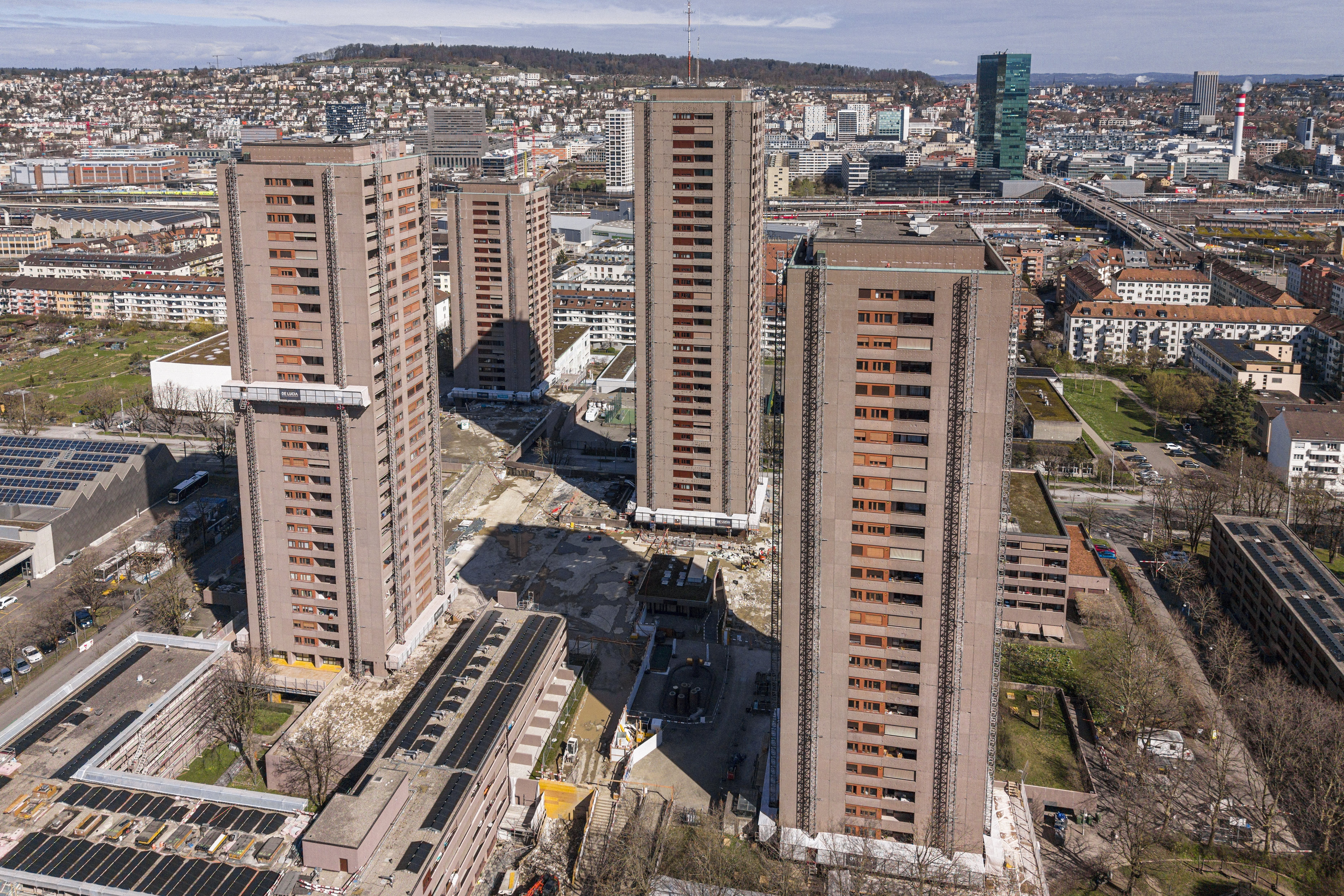
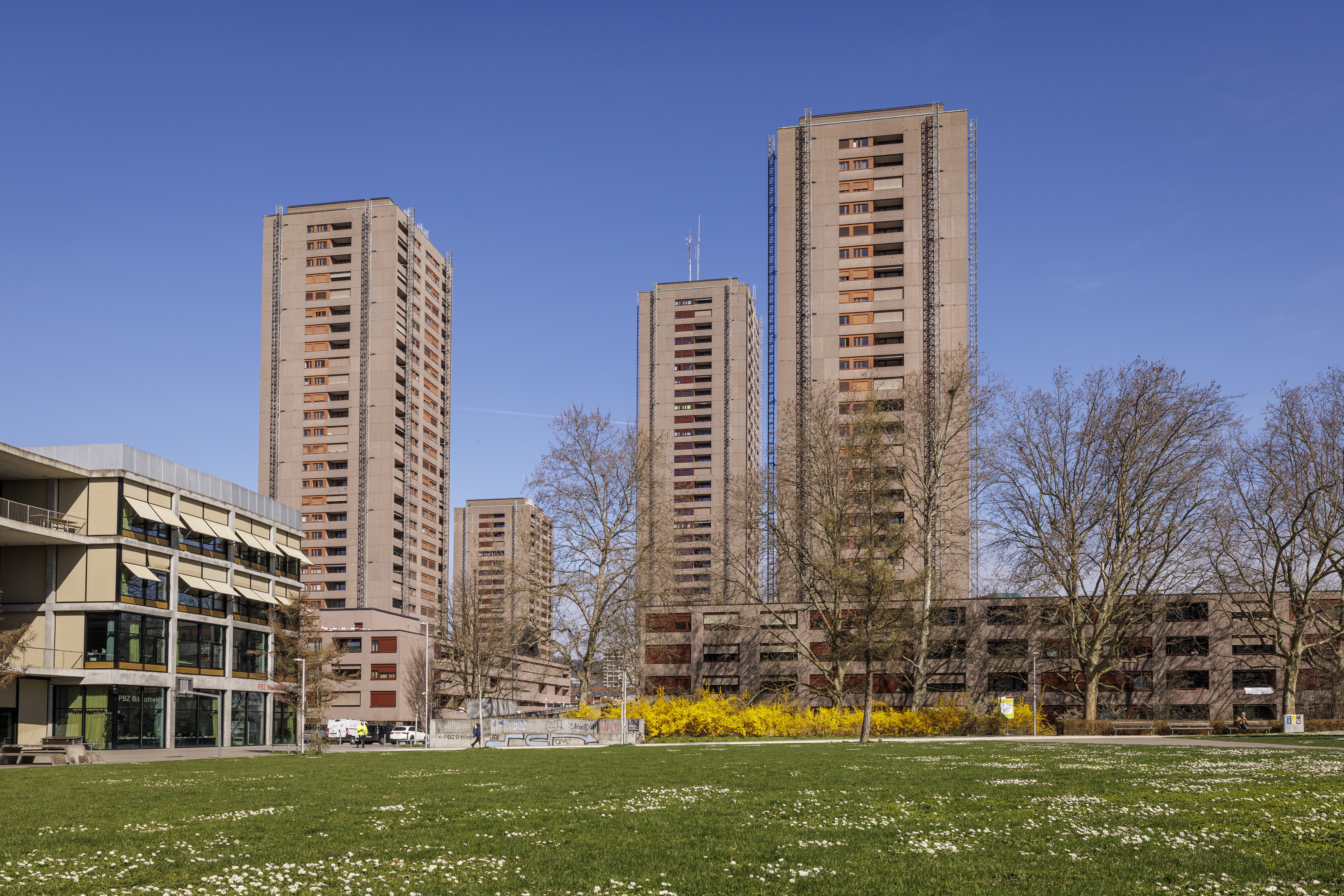
In Zurich, the Hardau II housing estate is visible from far and wide. Its four brown-red high-rise blocks, reaching heights of up to 95 metres, dominate the city’s skyline. Built in the 1970s to designs by architect Max P. Kollbrunner, the Hardau II complex comprises, in addition to the four high-rise blocks, two four-storey residential blocks each containing five apartment blocks, a U-shaped retirement estate, two multi-storey care homes and a multi-storey car park. Over 1,000 people live in the 570 flats on the Hardau II site.
Facade areas the size of almost six football pitches
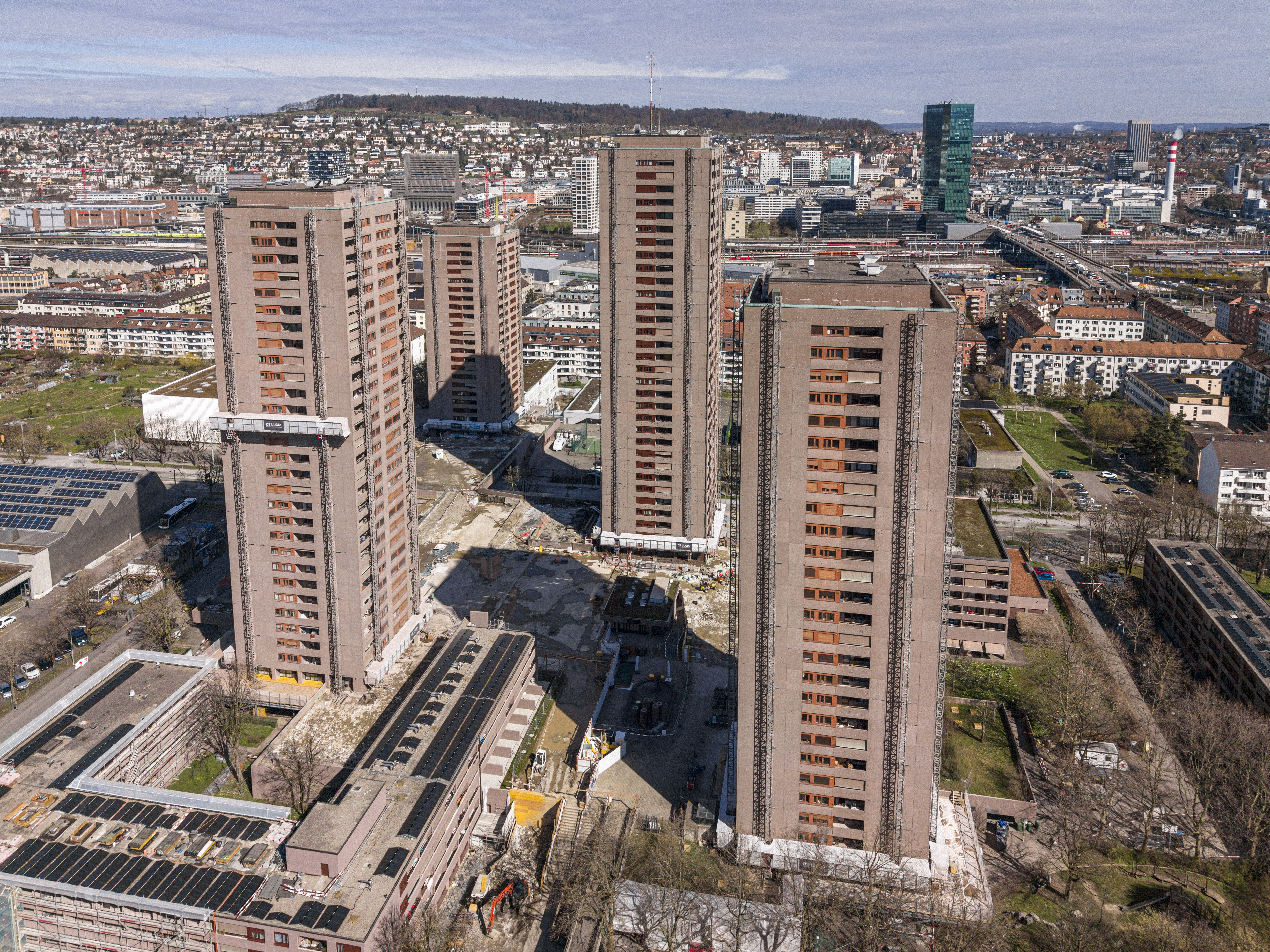
The estate is being refurbished whilst still occupied. Basler & Hofmann, acting on behalf of the City of Zurich as part of a general planning team, is responsible as the specialist planner for the refurbishment of the façades. The task is of almost dizzying proportions: the concrete façades cover a total vertical area of 40,000 m². That is equivalent to approximately 5.5 football pitches.
Listed status, difficult access and ongoing residential use
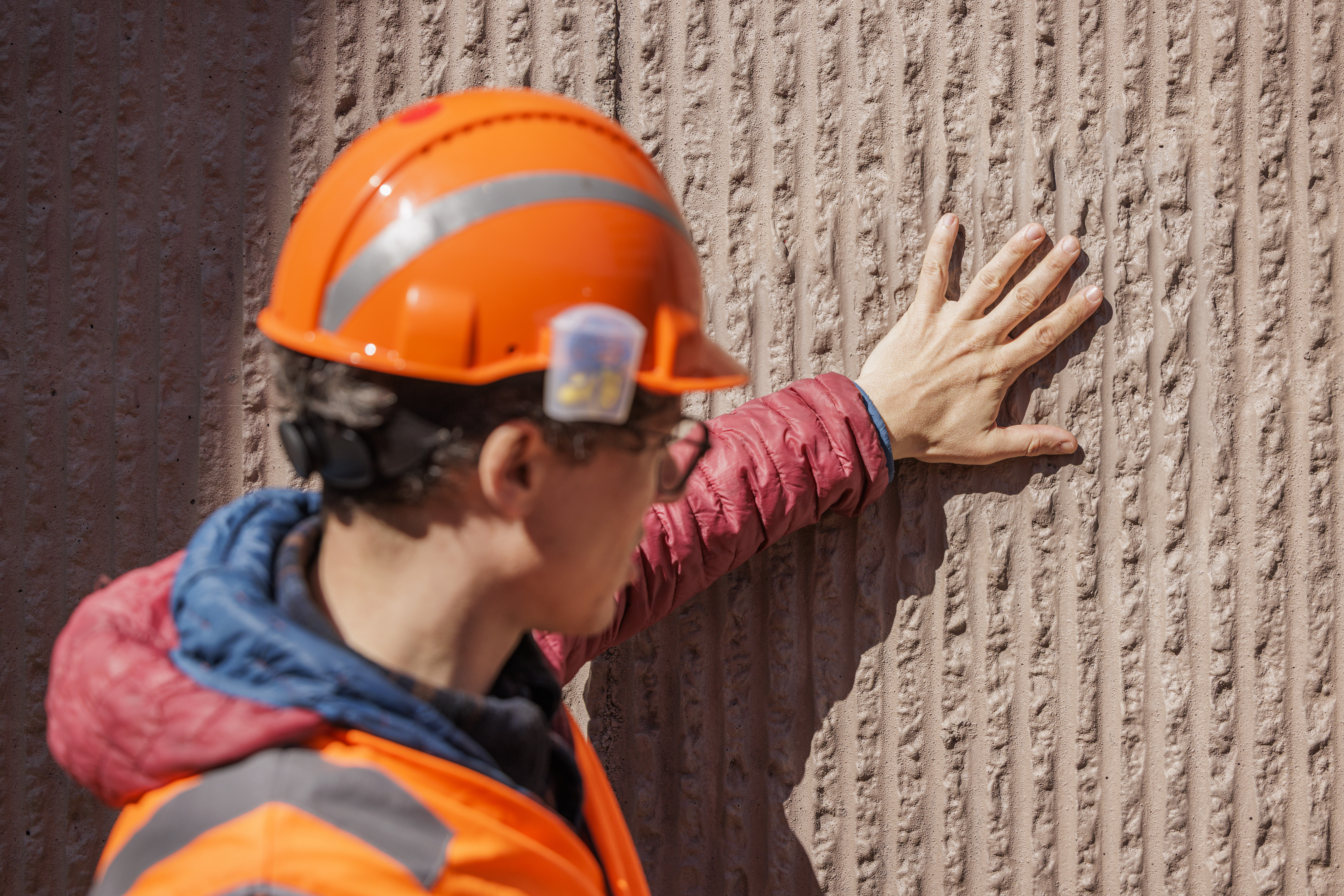
The scale of the exposed concrete façades is one of several major challenges posed by the repair work. The Hardau façades are listed by the city, and their appearance must be preserved as far as possible. They are specially coloured, finely textured and look as though hundreds of fine grooves had been raked into the sand. Access to the site is also a challenge; the courtyard area between the high-rise blocks lies above an underground car park that cannot support heavy machinery or cranes.
Added to this is perhaps the biggest challenge of all: the work is being carried out ‘whilst the building is in use’, meaning: whilst people are living here. The city, as the owner, has decided not to evict the tenants for the duration of the renovation. They are allowed to stay, but must put up with certain inconveniences that a building site entails. For the planning team and the contractors, this means that construction noise must be kept to a minimum, and the safety of the residents is the top priority.
During a site visit in spring 2026, people are coming and going. The entrances to the residential buildings are specially protected by a steel platform – nothing must fall during the renovation work. «The protective steel platforms were our suggestion», says Philippe Oesch, who has been planning the project since 2021. Philippe is a civil engineer at Basler & Hofmann and is on site today as technical site manager. Our company is supporting the general contractor team with the façade restoration, as well as with structural engineering, safety and site logistics.
Carbonation makes renovation necessary
Crumbling fragments of façade concrete were the trigger for the repair work. Following a façade inspection in 2014, the owner, the City of Zurich, decided to carry out a complete, full-surface repair of the concrete elements and joints. The damage analysis revealed that the spalling concrete particles were primarily due to the corrosion of the reinforcing steel resulting from carbonation of the concrete. During carbonation, the concrete reacts with CO2 from the air and loses its protective function, causing the underlying reinforcement bars to rust. This rusting causes the steel to expand in volume, ultimately leading to concrete spalling.
A lot of manual labour for listed grooves
We head up to the 25th floor of a residential tower with Philipp Oesch and climb onto the roof. The view is magnificent: to the south, Lake Zurich and the Alps glisten; to the north, the Prime Tower stands sentinel; to the east, the ETH dome towers over the old town; and to the west, far below us, lies the Letzigrund Stadium. Up here, at a height of almost 90 metres, concrete repair specialists from De Lucia Bautenschutz und Renovationen AG are currently at work.
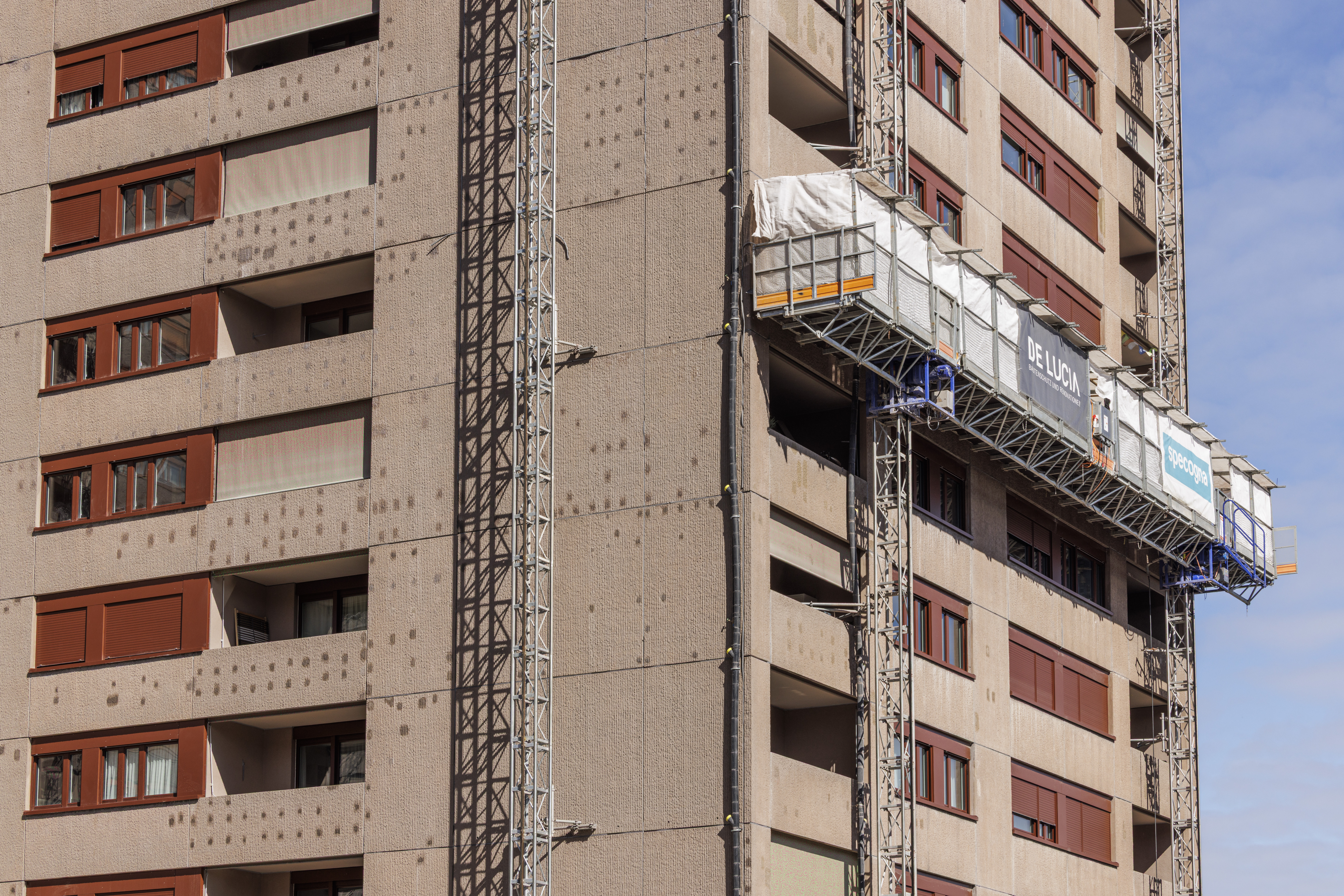
The specialists are working on a lifting platform surrounded by thick tarpaulins. The tarpaulins prevent anything from falling down during the work. At the same time, they serve as sound insulation and as weather and visual protection for the workers. Behind the tarpaulins, the workers detect the damage and look for weak spots on the façades. They chisel away the damaged areas, apply corrosion protection to the exposed reinforcing bars, fill the holes with mortar – and re-profile the façade grooves and ridges by hand. Finally, paint and surface protection are applied.
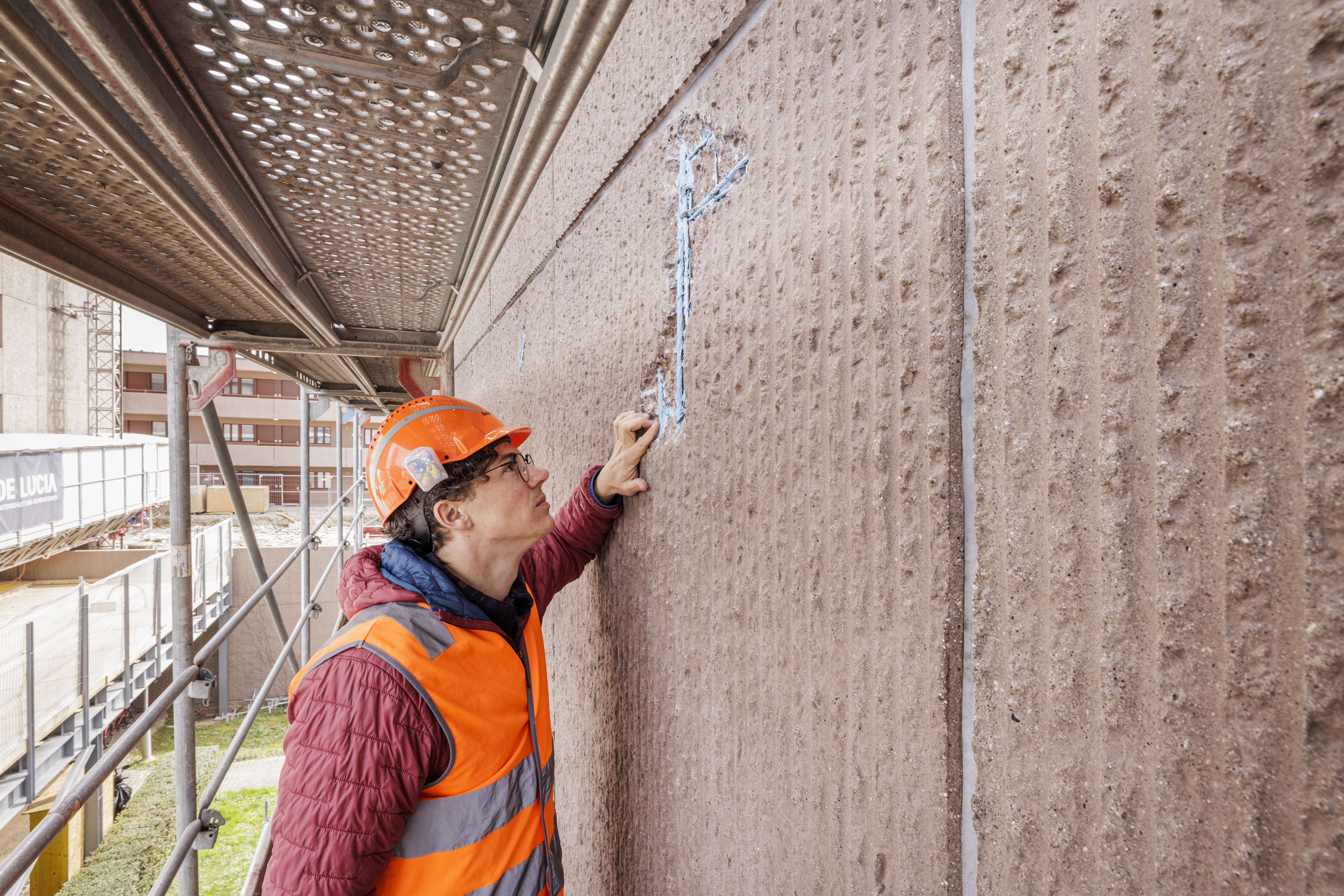
A great deal of manual labour is required on the Hardau façades to preserve the listed structure. Using an iron rod, the construction specialists first carve fine grooves into the concrete, then shape their crests with a hammer.
Scalable renovation method developed
«This concrete façade repair requires top specialists,» says Philippe Oesch. Choosing the right construction company was one piece of the jigsaw in the planning work carried out by the engineering experts at Basler & Hofmann. Before that, Philippe and his team had already achieved a great deal: they had assessed the damage, developed a renovation method that works on a small scale and can be scaled up to large areas, and summarised all the work steps in a plan of action. Our team then set out to find precisely those construction specialists capable of carrying out this large-scale yet meticulous restoration.
«Once we had developed the renovation method, the construction companies applying for the contract had to demonstrate, using façade samples, how they intended to carry out the work,» reports Philippe.
Drone flights to capture images of the façades
It is now midday. The lift platform carrying the skilled workers glides down the façade, emitting a beeping sound. The sunlight now illuminates the Hardau façades particularly well. Blue patches are clearly visible. They bear witness to the current construction phase on this high-rise: blue is the colour of the anti-corrosion coating applied to the reinforcing steel beneath the damaged and now chipped concrete façade.
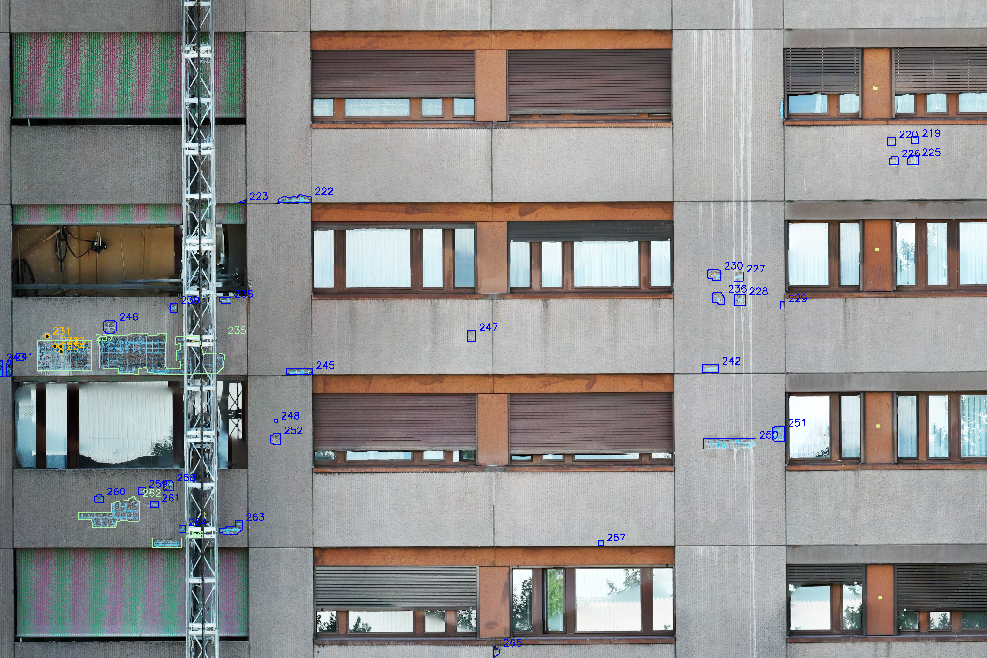
Because the blue makes the damaged areas clearly visible, now is also a good time to carry out the damage assessment. For this stage of the work, the surveying team from Basler & Hofmann flew drones over the high-rise building the previous day to take high-resolution photos of the façades – thereby documenting all the damaged areas that had been chipped away. Across all the Hardau façades, almost 30,000 damaged areas had been identified by this point.
The remuneration for the construction work is calculated on the basis of the damage assessment. At the same time, it serves as construction documentation for the client.
AI innovation project
At Hardau II, using drones to assess the extent of the damage offered an additional benefit. «We came up with the idea of training an AI model to assess the damage using the photos of the damaged areas at Hardau,» explains Roger Dietschweiler, Head of Structural Maintenance and Industrial Buildings at Basler & Hofmann. This gave rise to an innovation project aimed at using artificial intelligence (AI) to automatically and efficiently determine the extent of the damage that the construction company needs to repair on the façades.
AI for identifying damage - and the extent of damage
AI for detecting damage – and assessing its extent
When it comes to a renovation project, the damaged areas are usually identified twice: during the preliminary project phase, the focus is first on detecting damage; during the construction phase (execution phase), the focus then shifts to determining the areas to be worked on by the building contractor (extent). In other words: during the preliminary project phase, long before construction begins, our planning experts determine what damage is to be expected, how much there is, and what the causes are. «Damage detection is usually carried out on-site,” says Roger Dietschweiler. For large and hard-to-access areas such as the Hardau façades, this is time-consuming and therefore a significant cost factor.
«To speed up damage detection, we therefore used drone imagery for Hardau II as early as 2021,» says Roger, «to supplement the on-site assessment of plinths and balconies.» At that time, however, the images were evaluated by eye on a screen.
In the following years, AI became a major topic, and Roger Dietschweiler and his team, together with specialists in BIM and digital solutions at Basler & Hofmann, launched an AI innovation project for damage detection. The team trained an AI model. This AI model has since been further developed into a damage assessment AI model for the construction phase. The drone photos taken in 2026 during the construction phase of the Hardau facades were used for this further development. On the other hand, human expertise and the practical experience of our engineers were required.
The drone AI method: a powerful new tool
«AI is getting better and better,» says Roger Dietschweiler. When the AI model was first applied to the latest drone photos taken during the damage assessment in spring 2026, it immediately identified the majority of all areas repaired by the contractor on the first high-rise building. For the second high-rise, the model was retrained using images of the problem areas it had not found during the first run. «The results were even better,» reports Roger, concluding: «A new tool for the rapid assessment of the contractor’s scope of work on large concrete surfaces was born.»
Civil engineer Philippe Oesch, who regularly inspects the repair work at the Hardau II construction site, sees the potential of combining drone photos and AI for damage detection in the preliminary project phase and for assessing the extent of the damage during the construction phase. «AI-assisted damage detection on concrete surfaces is a powerful tool for concrete repair,» he says.
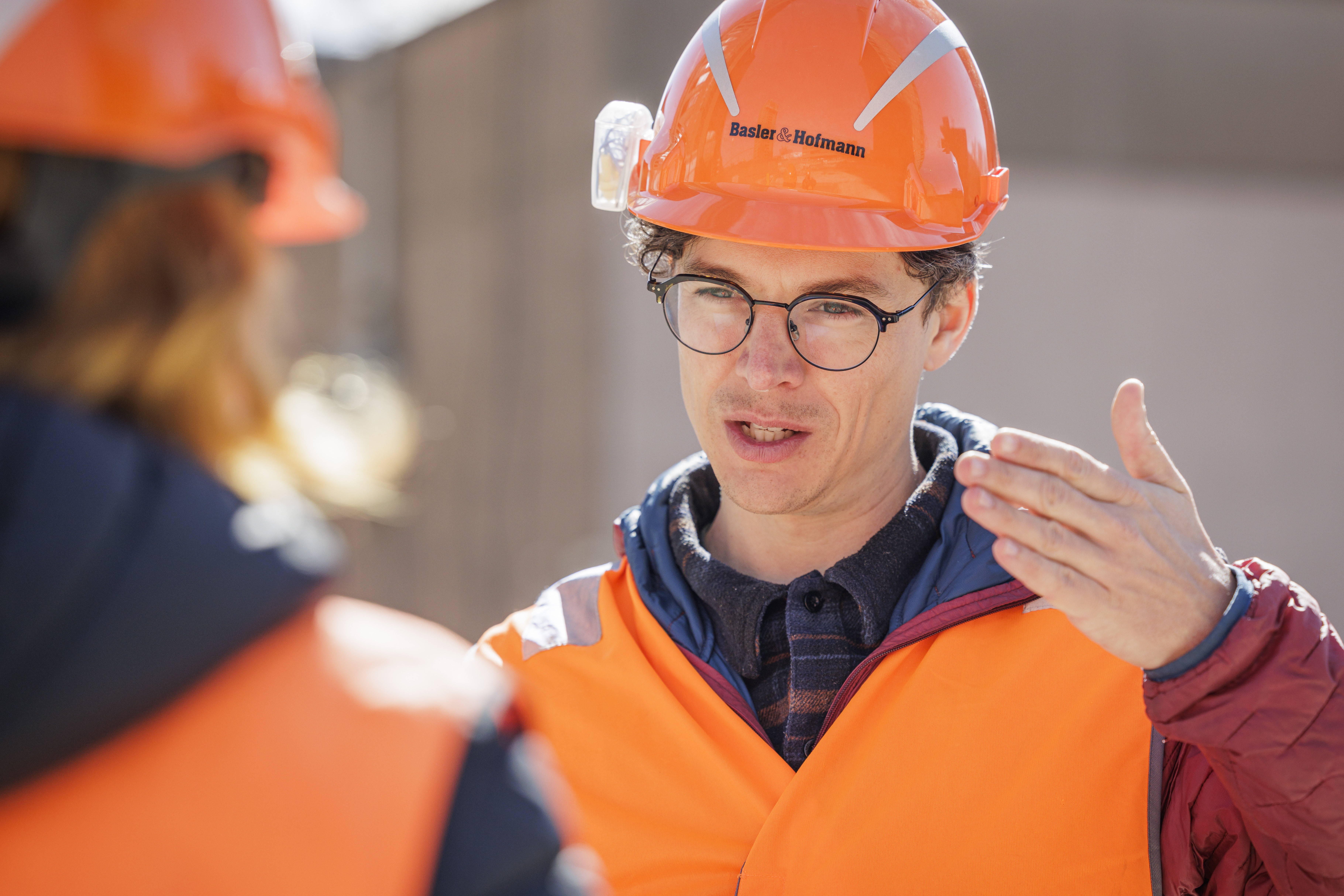
Our structural maintenance specialist Roger Dietschweiler is also convinced of this: «It’s brilliant that we can now use drones and AI to assess the extent of damage. Assessing the extent of damage will be many times faster than having to do it by hand on scaffolding, as has traditionally been the case.»
Basler & Hofmann plans to use the drone-AI method for other types of large surfaces soon. Not just for concrete façades, but also for other façades, as well as for roofs, tunnel walls or road surfaces that need repairing.
Hardau: Functional façades by 2027
On the Hardau site, the refurbishment of the façades is expected to be completed in early 2027. People will then be able to live in towers whose exposed concrete façades will continue to protect the buildings safely and withstand the elements for another 40 years. And which, moreover, will look as though the ravages of time have hardly left a mark on their grooved and textured surfaces.