
First Minergie-certified development in Central Switzerland


Near Lucerne train station, the ewl site - one of Switzerland’s first Minergie-certified developments - is set to be completed by 2032. It will provide ample housing and create several hundred jobs. Basler & Hofmann is assisting with the sustainability certification of this major project, among other tasks. In an interview, Roger Seiler, project manager at Halter AG, discusses the challenges and the site’s climate-friendliness.
This is a major urban development project for Lucerne: on a site of approximately 20,000 square meters, the General Building Cooperative of Lucerne is constructing affordable housing, senior housing, and new facilities for ewl and city departments. In addition, the Lucerne City Fire Department, the emergency medical services of the Lucerne Cantonal Hospital, and the Pilatus Civil Defense Organization are moving into the former gasworks site.
“The site is characterized, among other things, by the diversity of its uses. Usage-specific structures in the basement and, in some cases, increased load-bearing requirements—such as for the fire department’s parking garages—require a greater volume of concrete. Therefore, one of the various challenges was to still meet the Minergie-Areal requirements for gray greenhouse gas emissions. Thanks to interdisciplinary collaboration, we succeeded in achieving this for the provisional certification,” says Christoph Lehmann, Team Leader for sustainable building at Basler & Hofmann. In addition to supporting the Minergie-Areal certification, Basler & Hofmann is involved in the project—which is being implemented by Halter AG as the overall manager—across various disciplines. These include geotechnics, special civil engineering, seismic design, and property protection.
In an interview with Minergie, Roger Seiler, project manager at Halter AG, discusses the background of the Minergie-Areal certification and the challenges involved in the sustainable development of a site of this size.
Why was the decision made to pursue Minergie-Areal certification for the ewl site? What were the key factors?
Roger Seiler: According to the general land use plan, the ewl site was originally intended to be certified as a 2000-Watt site. Since this certification will no longer be awarded after the end of 2023, the Board of Directors of ewl-Areal AG decided at the end of 2024 to use Minergie-Areal as a suitable successor standard. After a comprehensive evaluation of the two successor labels—Minergie-Areal and SNBS-Areal—the Minergie-Areal certification proved to be the more suitable solution, as it optimally reflects the requirements of the general land use plan regarding project progress.
In your opinion, what are the benefits of the Minergie-Areal standard?
Roger Seiler: The Minergie-Areal standard provides a clear focus on energy-related issues, both during construction and operation. The structured breakdown into five thematic areas—such as individual buildings, site management, energy and greenhouse gases, comfort and climate adaptation, and urban transportation—enables a holistic view of the site. We also appreciate the constructive collaboration with the Minergie certification body, which enables a solution-oriented implementation of project-specific requirements. The City of Lucerne’s Environmental Protection Department cooperatively supported the selection of the appropriate successor instrument for the design plan specifications.
What are the biggest challenges regarding site certification for the ewl site?
Roger Seiler: A key challenge lies in meeting the PV requirements: Despite high coverage density on the roof surfaces, these alone cannot fully meet the requirements, which is why additional facade surfaces must be covered with PV modules. However, due to shading—both from within the site and from adjacent buildings—not all facades are equally suitable. Additionally, the integration of the historically protected Red House, which cannot be certified under Minergie, requires a nuanced approach at the site level. Thanks to constructive collaboration with the certification body, pragmatic solutions were found that meet both the label’s requirements and the project-specific conditions.
What do these solutions look like?
Roger Seiler: The photovoltaic system was systematically optimized following a comprehensive analysis. The focus is on the roof surfaces of both phases. In addition, after a thorough review by the electrical engineer, various optimally oriented facade surfaces on the ewl office building were also equipped with photovoltaic systems. Due to new construction currently in implementation on the neighboring property, the facade PV area had to be partially reduced to account for future shading effects. In total, approximately 1,040 kilowatts-peak are planned across both phases.
What sets the ewl site apart in terms of sustainability, or what makes it special?
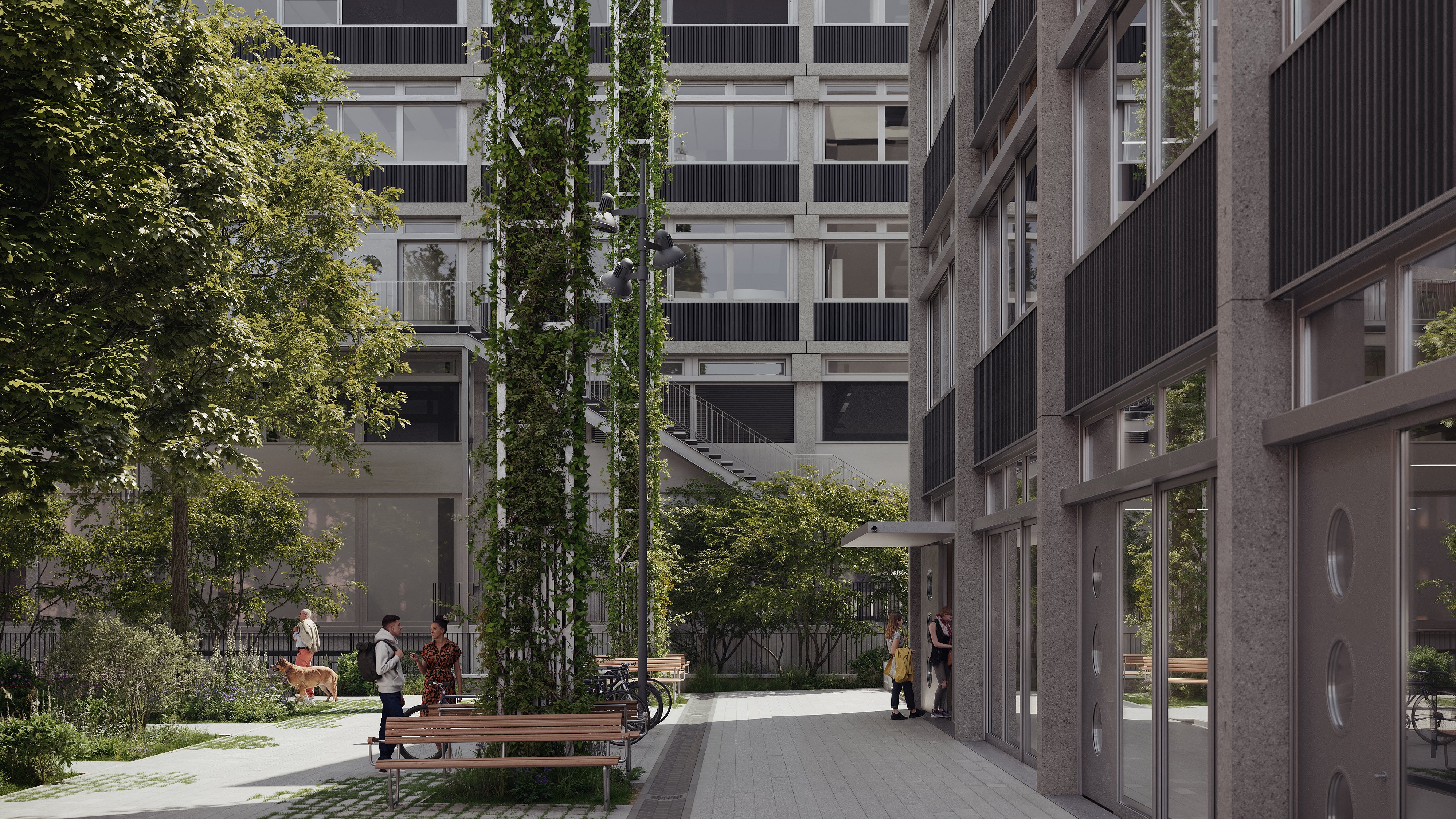
Roger Seiler: The ewl site takes a holistic approach to sustainability. Even in the early planning stages, attention was paid to reducing resource consumption during construction, and a wide range of ecological aspects were consistently integrated into the site planning. A key feature is the sustainable energy supply: The site is supplied with fossil-free heating and cooling almost exclusively through the use of lake water. With a letter of intent to source electricity from green energy certified under the “naturemade star” label, ewl-Areal AG aims for a fully renewable electricity supply throughout the entire operational lifespan. In addition, the site relies on an innovative mobility concept that specifically promotes accessibility via public transport and sharing services while reducing private motorized traffic on the site.
Are there any areas in this regard where you are breaking new ground?
Roger Seiler: The ewl-Areal benefits from the expansion of lake water utilization as a sustainable neighborhood energy hub that is also available to the wider neighborhood. This creates forward-looking infrastructure for sustainable heating and cooling beyond the site itself. In addition, a comprehensive energy management system is being implemented that balances energy procurement with on-site production, thereby optimally regulating consumption.