How do you build successfully today? Interview with a client project manager



Client project manager Tobias Schär supports building owners in the realisation of large construction projects. He understands their concerns and their joys. We want to know from him: what does it take to build successfully today? One thing is clear: it is no longer as simple as it was 30 years ago. Increasing social demands, growing regulation, conflicting goals and new disciplines make comprehensive expertise more important than ever.
Tobias, you oversee construction projects and have your finger on the pulse of the market. What is the mood among builders like?
Tobias: Lay clients in particular are often amazed at how complex and expensive building is today. It has become more complex. I would say that a project today takes twice as long from planning to completion as it did 30 years ago. The actual construction period, the implementation, doesn't take any longer. But today it takes more time for project planning, procurement and the planning permission process. People often try to shift the blame onto the approval authorities. But it's not that simple. There are also social reasons for this development. For example, more appeals are being lodged today, for example by neighbours, and resolving these takes time.
What used to be easier, say, 30 years ago?
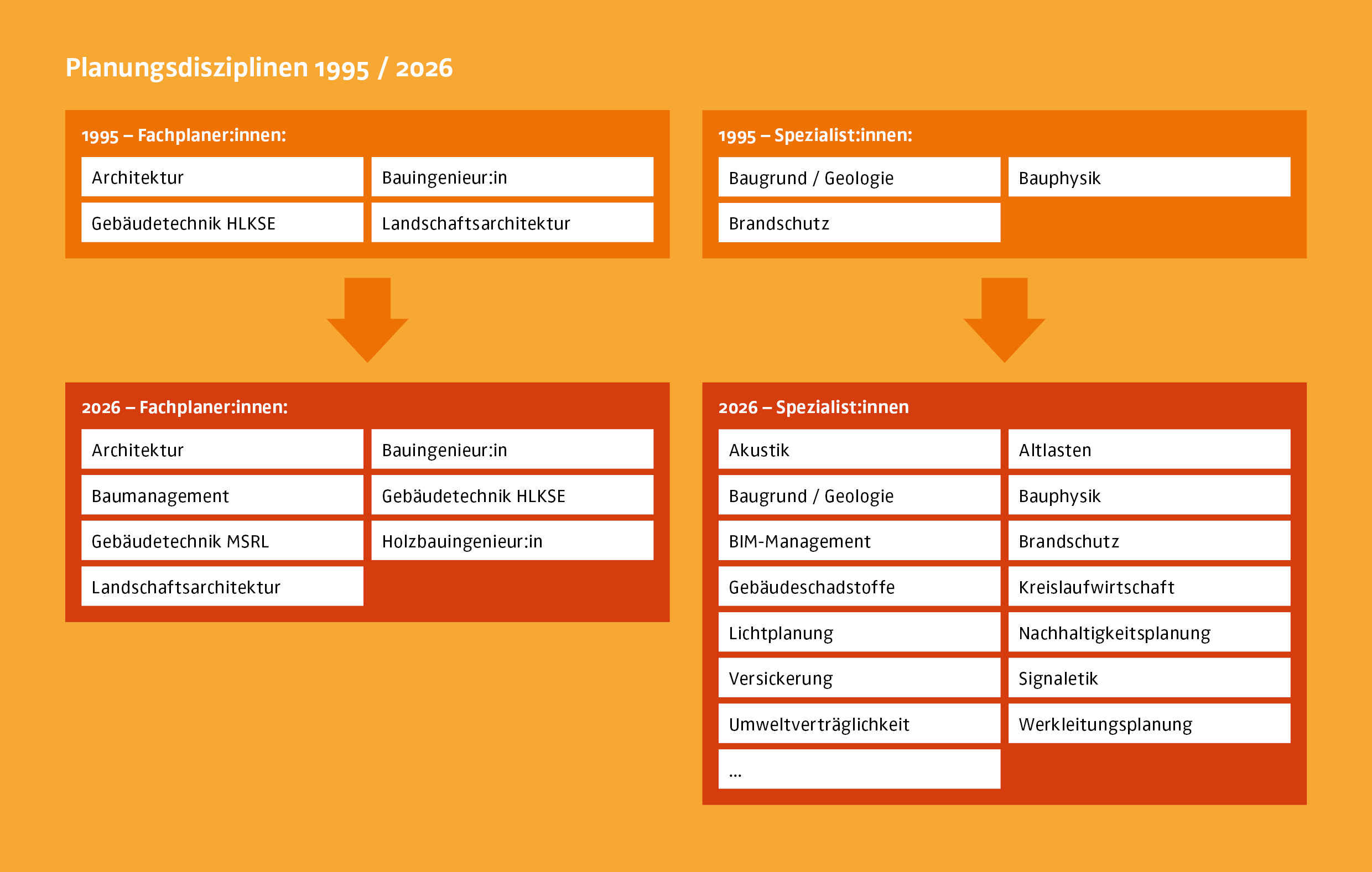
Tobias: 30 years ago, a client only commissioned a few planners with individual contracts. Today, general planning contracts dominate. The general planner assumes overall responsibility for the client and coordinates the various specialists. There are far more of these today than in the past, and the number of consultants and specialists has increased significantly. One example is the lighting planner, but specialist areas such as sustainability planning and works management planning also did not exist in the past. Nowadays, issues such as light pollution and urban climate also have to be taken into account and regulations regarding CO2 emissions are on the agenda. The canton of Basel-Stadt has already introduced such regulations.
What are the reasons for this increase?
Tobias: Today, new buildings and conversions have to meet a great many requirements and standards, for example in terms of safety and security, fire engineering, building pollutants, contaminated sites, noise protection, inclusion, environmental compatibility and urban climate. Modern buildings are also often highly technical, such as energy and IT systems. In short, successful construction today requires more knowledge and the ability to bring the many disciplines together to form a whole.
Is this why clients are increasingly engaging general planners?
Tobias: Many clients are trying to outsource their risks - in other words, to outsource planning interfaces to a general planner or, in the construction phase, to outsource cost, deadline and warranty risks to a total contractor who coordinates the companies on the construction site. But the client should be aware of this: Outsourcing does not necessarily make things easier. If a general or total contractor has to bear the cost risk, it will try to carry out its work as cheaply as possible to the minimum quality required. The client's influence is limited and additional requests are expensive. As the client's representative, it is my job to ensure that all work is completed to the agreed quality, on time and within budget.
When do you consider a project to be successful?
Tobias: When I started as in project management services 17 years ago, the goal was to complete a project on time and on budget. If that was achieved, then the project management services had been successful. Today I see it like this: if a project can be realized at all, that is already a success.
The time factor plays an important role: because there are so many stakeholders, requirements and standards, deadlines are less predictable. In addition, the response time of the authorities has decreased in some places - I know of authorities that are completely overloaded. This is another reason why planning permission processes take longer. Nowadays, it is not unusual for conflicts of interest to arise in the early planning phases due to the large number of standards. In order to develop viable solutions, many discussions are held with official bodies. However, the statements made by the specialist bodies only become binding as part of the formal planning permission process. This means there is always uncertainty for the client.
Where does the multitude of standards come from?
Tobias: The main drivers are social demands: we want to live in a house that is free of pollutants, it should be barrier-free, no one should be able to injure themselves, everyone should be able to sleep without noise at night, the CO2 footprint should be as small as possible, the building should not contribute to overheating the city and generate as little operating expenditure as possible. All these demands are reflected in standards, regulations and increased requirements.
Do you have any examples of conflicting objectives when it comes to standards?
Tobias: Let's take the expansion of the Brunnenhof housing estate in Zurich as an example, which I am accompanying on behalf of the client, the Foundation for Family Housing (SFW). Among other things, there was a conflict of objectives here between the addition of renewable energies, specifically photovoltaics systems, and the improvement of the urban climate. The roof area of the high-rise building was too small to cover the entire legally prescribed minimum requirement. The client therefore wanted to install additional photovoltaics on the façade. At the same time, the city demanded a large number of new trees to provide shade and reduce heat. However, the trees would have obscured the façade panels.
I called in our photovoltaics expert Eric Langeskiöld to look for solutions. The solution was to relocate the photovoltaics system to a neighboring building, which required an exceptional permit. We obtained it. The client decided with a heavy heart - due to a lack of efficiency and uncertainties regarding the fire engineering permit - to do without the photovoltaics system on the façade.
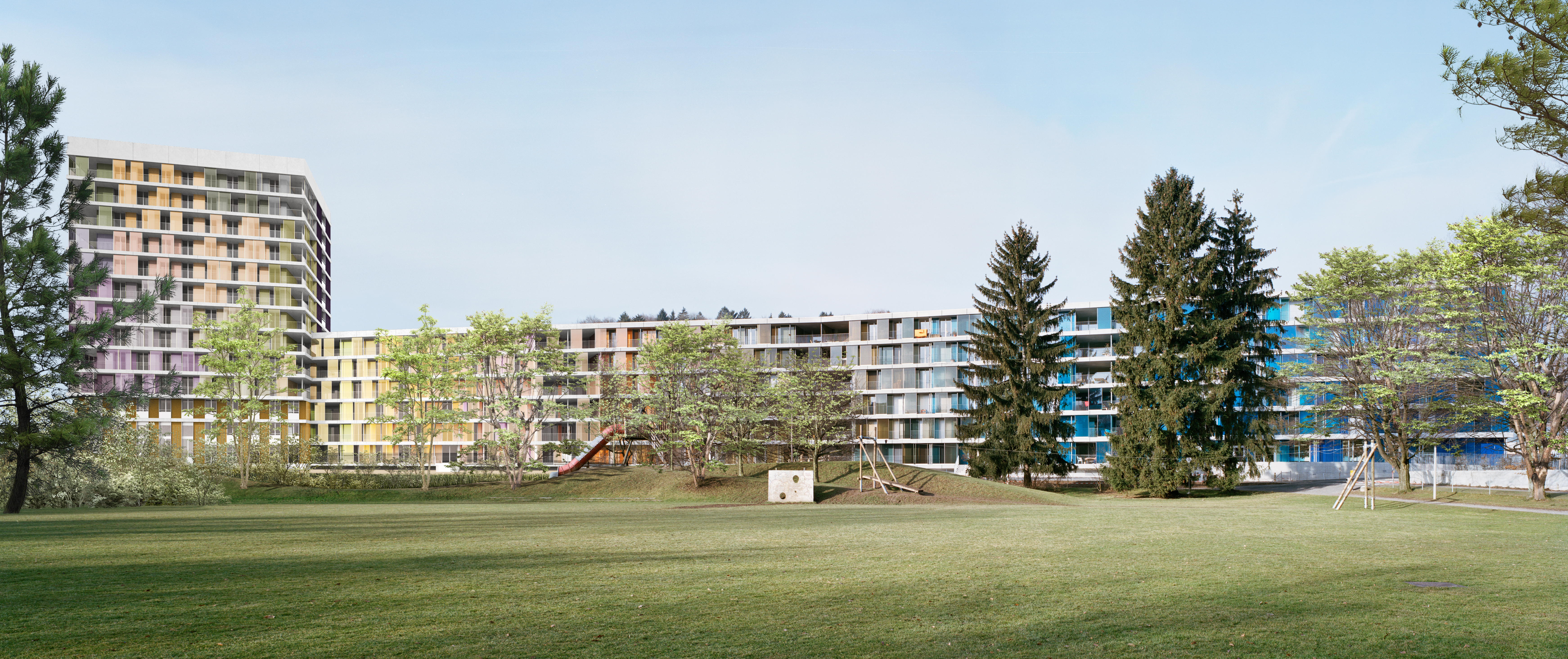
Tobias: There was another conflict of objectives between inclusion and traffic safety. In the case of Brunnenhof, there was a requirement to plan public use on the first floor, such as for a café or a store. Public uses, in turn, require nearby disabled access parking spaces. However, an access road that would not have endangered anyone was not possible close enough due to the complex traffic routing on Bucheggplatz.
The barrier-free parking space therefore had to be placed a little further away to ensure traffic safety. This exception was possible as part of an overall consideration in the design plan process.
So your job as a client project manager is to resolve what at first glance appear to be insoluble contradictions?
Tobias: Yes, also. As a client project manager, I advise clients on how to weigh up planning risks, such as those that can arise from conflicting objectives, and how to find solutions. It is my job to help the client to exercise their rights and obligations and to make their contribution to the success of the project. The attitude of "he who pays, rules" is no longer sufficient to successfully complete a project. A client must actively specify requirements and organization and make decisions in good time.
What tips would you give an inexperienced client?
Tobias: It's very important to find the right planning partners; you shouldn't skimp on the evaluation. You need competent, experienced specialists who share the same understanding of the goal. A certain amount of composure can't hurt either. The client should be aware that it will be complicated and time-consuming. Inexperienced people are quickly triggered by difficulties; experienced builders look at the situation objectively and react in a considered manner. It is also important to have an overarching plan of how to achieve the goal - in the knowledge that this will have to be constantly reassessed and adjusted. I also advise clients not to get lost in the details, for example when it comes to budgets in the millions, arguing over a few francs, but to keep an eye on the big picture. And finally: optimism helps! With a good team, challenges can be overcome.
What do you wish for the future of construction?
Tobias: I would like the authorities to actively weigh up interests when there are conflicting objectives between requirements and specifications, and to be aware that they should also contribute to the ability to obtain planning permission and to feasibility.
With regard to increasing regulation, I would like to see existing regulations simplified or abolished where possible. Today, new requirements are being added on top of existing ones without replacing them. This is increasingly leading to inconsistencies and a level of complexity that I believe will soon no longer be manageable by the planning team alone.
As far as objections are concerned, I would like to see higher hurdles for unfounded appeals, i.e. appeals that are merely aimed at delaying the project or obtaining compensation.
I would like to see all-round appreciation and respect in the project team, because today's challenges can only be overcome as a team.
Competencies and skills to build successfully
Realizing a concept design today requires many skills: construction know-how, knowledge of sustainability and Environmental Engineering, financial knowledge, an overview of planning standards and construction law, knowledge of political procedures, buyer competence, project management skills - and much more. In addition to specialist skills, other skills help to increase the chances of success of a concept design. Five tips for builders.
If you want to build successfully today, you should ..
1. know your own needs and be able to formulate them clearly.
The operating procedures, the space required, the necessary requirements and your own expectations must be declared as clearly as possible.
2. put together the right team.
You need experienced specialists from all the disciplines involved who are willing and able to work together.
3. adapt to changes.
The client needs an overarching plan - but also the awareness that the plan will need to be adjusted again and again during the course of the project.
4. choose the best form of organization.
Anyone who builds should be able to assess what the optimal implementation and contract model is for their own project.
5. Have a tolerance for frustration.
Not everything will run smoothly. Calmness helps!
Not everyone who is faced with a construction task comes from the construction industry. Anyone who is realising a large construction project for the first time or is faced with a challenging starting point would therefore be well advised to enlist the help of an experienced sparring partner right at the beginning of the project – be it a client consultant or a client representative.