"It takes ingenuity to preserve something"


To preserve or to demolish? Roger Dietschweiler, Head of Structural Maintenance and Industrial Buildings at Basler & Hofmann, believes that property owners still too often opt for demolition. In this interview, he explains why continuing to build on existing structures is worthwhile, what actually causes buildings to age, and why many buildings from the era of high economic boom now require renovation.
Civil engineer Roger Dietschweiler is fascinated by historic structures such as the famous greenhouses at Kew Gardens in London. He values material-efficient construction and well-thought-out constructions. As head of structural maintenance, he advises public and private clients who wish to remodel, expand, or renovate existing buildings. His team plans all types of repairs. Currently, for example, they are working on the repair of the historically protected Aubrugg (ZH) wood-fired power plant, the redevelopment of the Grabengut Ice Sports Center in Thun, repairs to various parking garages, and the repair of historically protected facades on schools and residential buildings.
Roger, your work focuses on preserving existing structures. Can every structure be preserved?
Roger Dietschweiler: With enough money, time, and expertise, a great deal is possible. For example, in Zug, we preserved a historic building whose useful life had actually come to an end. The oldest structural elements were 500 years old. The building had been remodeled countless times. The structure remained intact only because so many renovations were interwoven with one another. But the building has historical value. We managed to preserve the existing structure. In consultation with the historic preservation authorities, we assessed nearly every component individually and decided whether it should be kept, reinforced, or replaced. Today, the building is inhabited, and the café operates on the ground floor.
What are the major challenges in structural maintenance today?
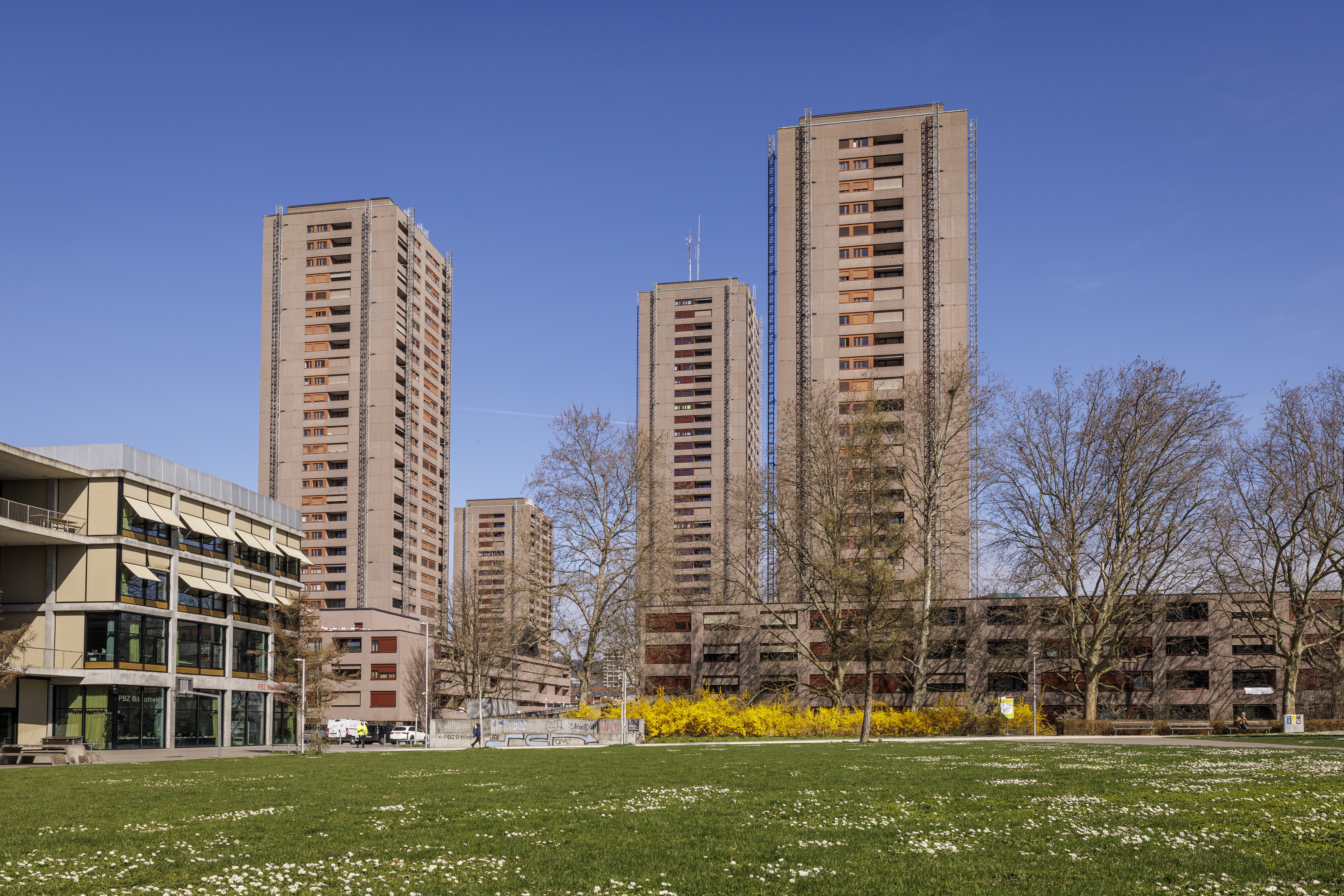
Roger Dietschweiler: The real challenges are the buildings from the economic boom period. As a society, we face the question: how can we preserve all these buildings from the second half of the 20th century? Almost everything we see today was built back then. A typical example is the Hardau II housing development in Zurich from the 1970s, which is currently being renovated. These buildings have a problem common to many exposed concrete facades from that era: The concrete cover over the reinforcement bars was made too thin, which leads to corrosion of the reinforcement. Building this way was in accordance with standards at the time. People underestimated how intensely and quickly carbonation occurs due toCO₂ in the atmosphere.
Are the buildings from the economic boom era now reaching the end of their service life?
Roger Dietschweiler: In civil engineering, we don’t talk about “service life” but rather “useful life.” We specify this timeframe for the building owner in the usage agreement so that they know how and for how long the structure can be used. The service life is always based on the assumption that maintenance will be performed.
In the field of infrastructure, such as roads or bridges, maintenance is usually integrated into the planning, as maintenance measures in the road network must be coordinated with one another.
In structural engineering, particularly for private clients, maintenance is unfortunately often neglected. Many property owners often wait until a defect is obvious before taking action. For example, the fact that a roof will no longer be watertight after 20 years is actually foreseeable, since waterproofing has only a limited lifespan. At some point, repairs will be necessary; this is true for all building components.

How long will a structure built today last?
Roger Dietschweiler: A building’s structure built today can easily last 100 years or more. The lifespans of other building components, such as the building envelope, are much shorter. However, it is generally not the condition of the structure itself, but rather changing usage requirements, that signal the end of a building’s life.
What causes a building to “die”?
A building does not die. It becomes meaningless: when its use becomes obsolete, when it no longer has any economic or sentimental value. When it’s nothing more than a pile of materials. Then re-use is the last option.
Can old things have advantages?
Roger Dietschweiler: Yes. Anything that is old and still functions has proven itself structurally sound. If a construction has already lasted 50 years, there’s a good chance it will survive another 50 years unscathed. Any structural defects would have become apparent in the meantime. A proven construction is something of lasting value, and you should not destroy something of value without necessity.
Is it always more sustainable to preserve a building?
Roger Dietschweiler: The simple answer is yes. But you always have to look at it on a project-by-project basis. We can use life cycle assessments of different options to determine whether new construction or preservation results in fewerCO2 emissions. We do this quite often in structural engineering, and the general rule is: the fewer changes made to the structural works, the more sustainable the solution. Buildings are often demolished unnecessarily because a deficiency is suspected or because new construction seems easier than continuing to build within the existing structure. It takes ingenuity to preserve something.
Are there other reasons to preserve a building?
Roger Dietschweiler: There are many reasons to preserve and continue building on an existing structure. Existing buildings already hold so much: history, identity, materials, and energy. Social or cultural value can be a reason: A building that has stood in a town center for decades creates a sense of identity.
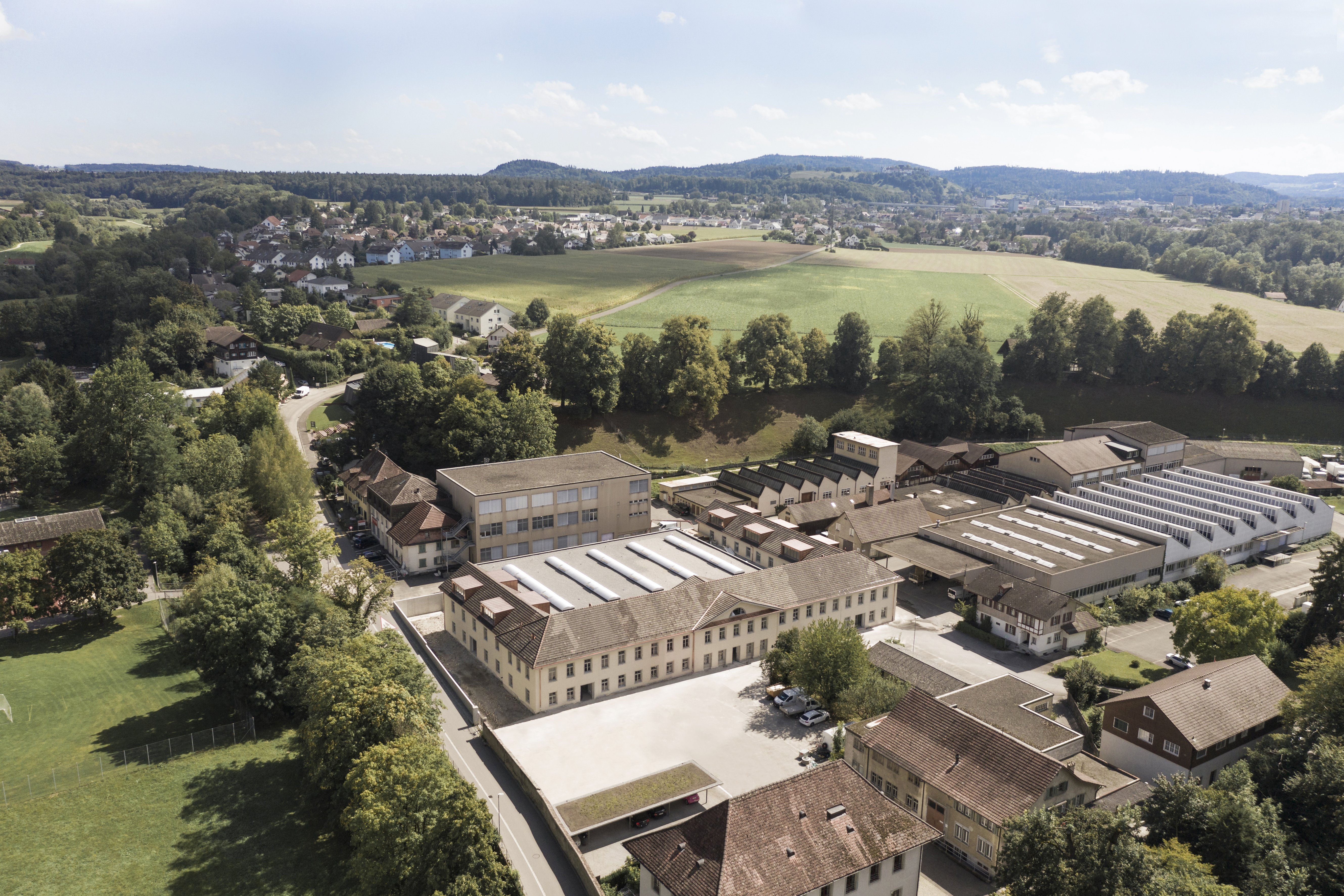
Furthermore, repurposing opens up opportunities. Take, for example, an industrial building with high rooms and ceilings capable of supporting ten times the load of a residential building. In a building like that, dreams can come true. This allows for suspended ceilings, platforms, and diagonal sightlines, and there’s plenty of space for building services. These are things you couldn’t afford if you were to build a new residential building. The old can be a resource, a source of wealth.

When you look 30 years into the future, how will we be building?
Roger Dietschweiler: We’ll build in a simpler way again and use fewer materials, because energy will be expensive and resources won’t be as readily available. We’ll focus more on reusability and on ensuring that materials can be separated again. This means, for example, that components will be joined rather than glued.

![[English] Holzbau Hybridbau](/fileadmin/_processed_/b/a/csm_0_Header20260507_Bau_Holz_3OG_gerade_ec0957440e.jpg)