Digital Management of Rail Facilities: A Guide to Get You Started


For large rail companies, digital, integrated management of their rail infrastructure is standard practice. An increasing number of smaller rail operators are also recognizing the need to improve their data management. Basler & Hofmann has developed a guide for them to help them get started with the digital transformation of their infrastructure management. We spoke with project manager Nicolas Schmidt about the background of this initiative.
Rail tracks, overhead lines, signals, signal boxes, and other safety systems—as well as civil engineering structures such as bridges, tunnels, and service pipes—must operate safely around the clock. At rail companies, the Facilities Management department is responsible for this. It collects and manages data on the condition of the infrastructure. Digitalization enables simpler data management and optimized, data-driven decision-making. Smaller Swiss rail companies also want to seize this opportunity, as Nicolas Schmidt, Head of Geoinformatics at Basler & Hofmann, explains.

Nicolas, your team from the Geoinformatics department worked with experts from eight rail companies to develop the guide “Digitalization in Asset Management.” What is it about?
Nicolas Schmidt: The guide helps rail companies gain a systematic overview of where they stand in terms of asset management and where there is a specific need for action. It provides a step-by-step guide to the issues that must be clarified before decisions are made regarding a technical system for digitalization.
How did you realize that smaller rail companies were seeking support with digitalization?
Basler & Hofmann has been active in railway construction, infrastructure management, and railway GIS for many years. As an engineering and planning firm, we are in regular contact with many railway operators. Twenty years ago, we developed the “Fixed Assets Database” (DfA), the central geoinformation system (Railway GIS) used by SBB and other major railways in Switzerland. The guide now focuses on the needs of small and medium-sized railway companies. It is the result of a strategic discussion to which Basler & Hofmann invited several operations. During these discussions, it became clear that many smaller railways are at a similar stage: they want to further digitize their asset management.
Why do these railways want to digitize their asset management?
Just like the major rail companies, small railways also want—and need—to have a very precise understanding of the condition of their infrastructure in order to ensure Safety and Security and plan investments more effectively. And like all infrastructure operators, small railways must also regularly submit a “network condition report” to the Federal Office of Transportation. Compiling such a comprehensive overview of all infrastructure is challenging. In some cases, we’re talking about over 100 kilometers of track, including overhead wires, cables, signals, and many other infrastructure elements.
How do small rail companies handle their asset management these days?
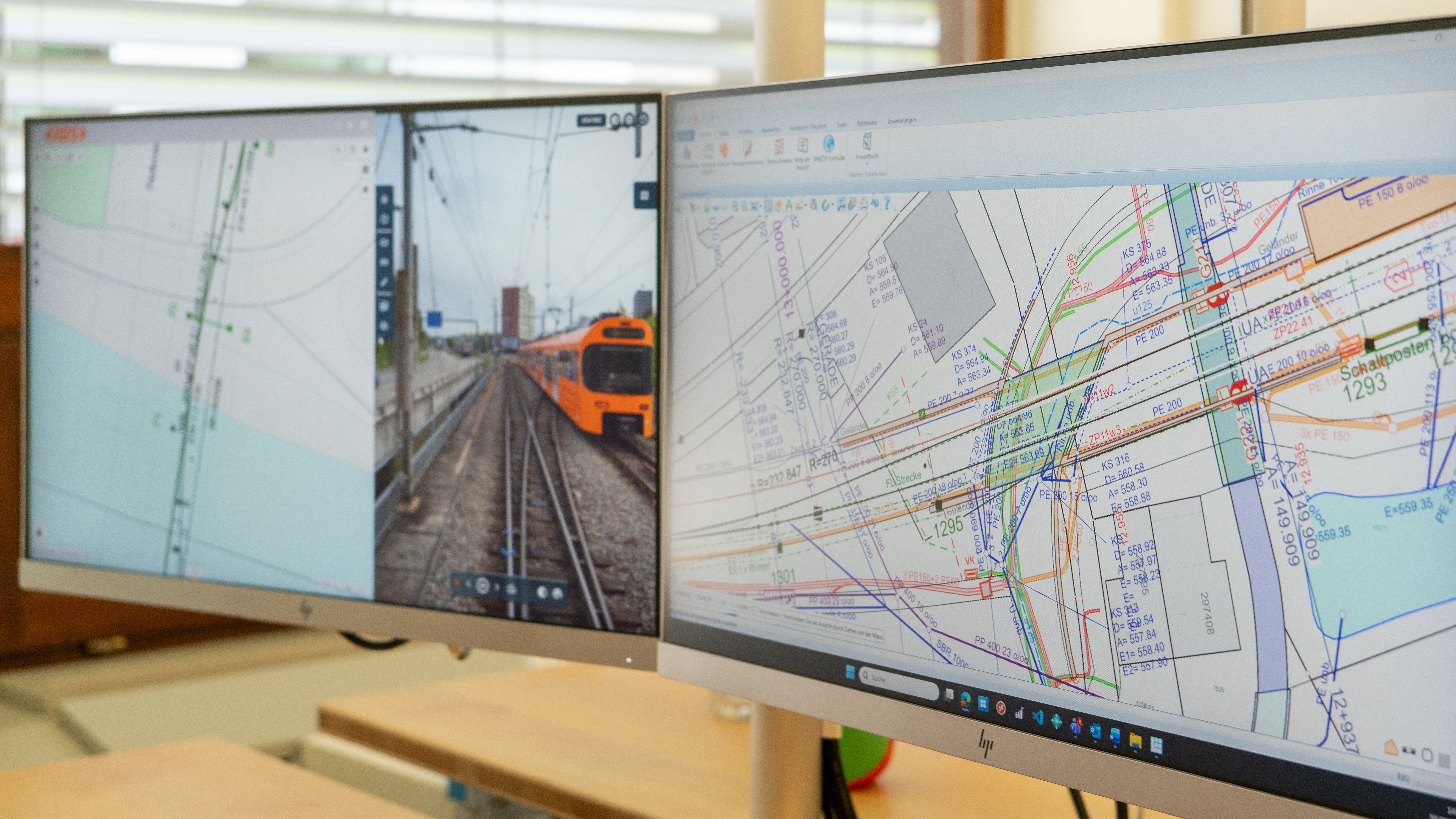
Railway operations have track inspectors who walk the tracks about every two weeks to check their condition. Some of these track inspectors still record their observations on paper or in Excel spreadsheets. Today, a great deal of knowledge about the condition of the tracks is scattered across lists and isolated technical systems, or resides in the minds of the specialists responsible for the infrastructure. Individual specialized departments, such as track maintenance or overhead wire maintenance, have their respective systems under control. However, there is a lack of an overall view and a system with high levels of sustainability and reliability for data management. Management, in particular, has a strong need for this knowledge to be consolidated into a central system rather than remaining solely in people’s minds, scattered across various lists, or stored in isolated systems.
How does the guide help these rail companies?
The guide highlights the most important aspects to consider when seeking to further digitize and integrate asset management. It identifies the issues that must be resolved first before any system or procurement decision can be made. Three perspectives have been incorporated into the guide: that of leadership, that of regulation, and that of accountability. Leadership requires a comprehensive view of the condition of the infrastructure in order to make strategic and financial decisions. Railway regulation aims to ensure safety and efficiency in rail service and defines corresponding requirements for the infrastructure that must be met. The accountability perspective defines who is responsible for which areas—and thus also who is held accountable if something goes wrong—and how collaboration takes place.
What key aspects should rail companies address first?
We have identified six key aspects that help railways assess where they stand today and what they could optimize. The guide walks users through these six aspects in the form of a checklist. It covers everything from data collection to data aggregation, diagnostic capability, action planning, organization, and the lifecycle of facility management. Diagnostic capability is a particularly important aspect.
What is meant by "diagnostic capability"?
It means that the system can generate reliable and meaningful information about the condition of the assets from various data sources. Asset management must always be able to accurately assess the condition of its assets, identify risks, and derive appropriate measures from them. It must be able to predict when specific maintenance tasks will be due so that investments can be planned for the short, medium, and long term.
What do you think asset management will look like in the future?
Many railways envision having a centralized IT system where all condition data from sensors, track inspections, and on-site inspections is continuously aggregated and made available in real time in the form of analyses, key metrics, maps, and reports—presented in a way that’s easy to understand and tailored to the user. They want a digital twin of their railway system. The path to achieving this is long and must be carefully considered. There is no one-size-fits-all solution for every railway. Company-specific factors—such as processes, management culture, organizational structure, existing systems, and data sources—must be taken into account. We recommend developing a roadmap that starts small and moves toward the target system step by step.
What’s next for the guide?
The guide “Digitalization in Asset Management” can be downloaded and tried out for free. We hope it will make the first step toward integrated, digital asset management easier for small and medium-sized rail companies. We look forward to your feedback. All feedback is welcome.
Case Study: SZU Sets the Course for Digital Transformation
The Sihltal Zürich Uetliberg Bahn (SZU) expects passenger volume to double in the coming years. To keep pace with this growth, it sought a solution to streamline its asset management and automate its reporting. The SZU turned to digitalization—and, together with Basler & Hofmann, implemented a rail GIS.
Read the case study now