
New SNBS label for the certification of sustainability in existing buildings


If we want to achieve the Swiss climate targets, we need to focus on the building stock. The Swiss Sustainable Building Network (SNBS) has therefore created the new "SNBS Existing Buildings and Operations" label. Basler & Hofmann has tested the new standard and is one of the first companies that can support real estate managers in certifying their portfolio.
It is understandable that, as a real estate owner or portfolio manager, you feel like you are in the middle of a jungle in view of the many facets and requirements surrounding the topic of sustainability. The need for guidance and reliable key figures is correspondingly great. While there is a comprehensive, market-recognized standard for sustainable building for new construction in Switzerland in the form of the "SNBS structural engineering", there has been no follow-up product for existing buildings until now. The Swiss Sustainable Building Network (NNBS) closed this gap on April 9, 2026 with the launch of the "SNBS Existing Buildings and Operations". The need is certainly there: Switzerland's existing buildings together consume 40% of the country's final energy requirements and are responsible for around a third ofCO2 emissions.* The new standard helps property owners and operators to assess their properties, optimize building operation, develop refurbishment strategies and provide proof of sustainability to investors.
Certified sustainability analyses for existing buildings
Basler & Hofmann's sustainability experts have tested the new standard in a pilot phase. In this interview, Alexandre Pâris, one of Switzerland's first "Certified Experts" for "SNBS Existing Buildings and Operations", discusses the challenges involved in the sustainability analysis of existing buildings, for whom certification according to "SNBS Existing Buildings and Operations" is worthwhile and how he experienced the pilot certification of a Basler & Hofmann commercial building in Esslingen.
When it comes to sustainability standards for real estate, there is often talk of a "label jungle". The Swiss Sustainable Building Network (NNBS) is launching another label with "SNBS Existing Buildings and Operations". What is it for?
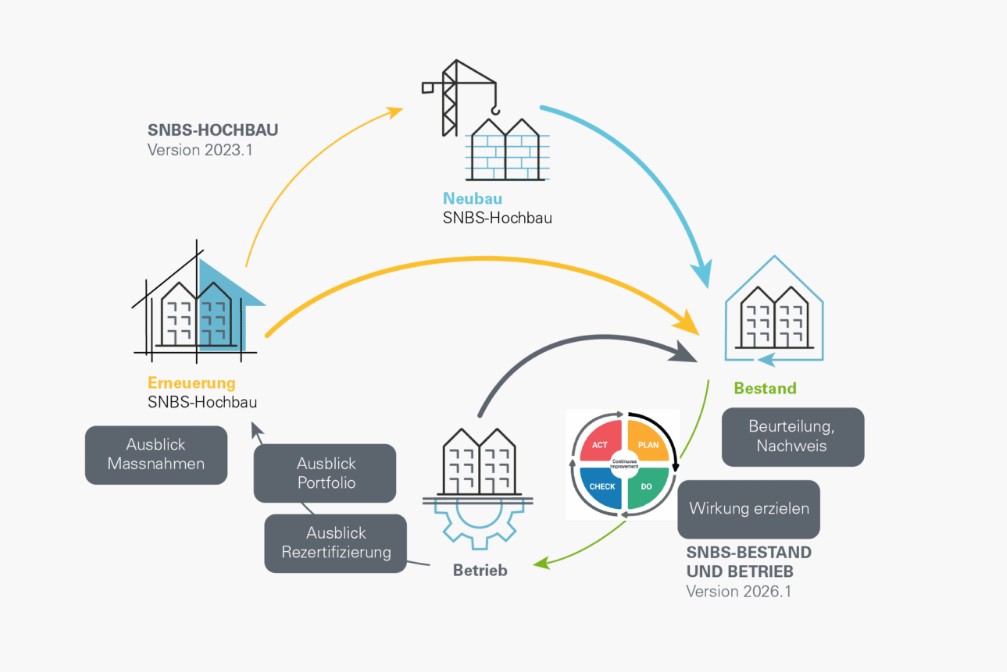
Alexandre : The "SNBS Structural Engineering" has established itself as the most comprehensive sustainability standard for new construction in Switzerland. With the "SNBS Existing Buildings and Operations", the NNBS network aims to ensure label continuity over the life cycle of real estate. The assessment criteria of both standards are based on the same structure. As far as alignment with international standards is concerned, the NNBS says it is already in intensive discussions with GRESB, the Global Real Estate Sustainability Benchmark. The aim is for the new standard to be recognized as an "Operational Green Building Certification Scheme", just like the "SNBS Structural Engineering". Due to the high level of acceptance of the "SNBS Structural Engineering" on the real estate market, I assume that the new standard will quickly establish itself on the market.
What types of real estate are suitable for the new "SNBS Existing Buildings and Operations" standard?
Alexandre: The standard is suitable for all categories of use, i.e. residential buildings, commercial buildings, shopping centers, school buildings, etc. The only condition is that the buildings must be at least three years old. The standard helps real estate owners and operators to evaluate individual buildings as well as their entire portfolio according to uniform sustainability criteria and ultimately define a real estate strategy.
What sustainability criteria does the new standard take into account?
Alexandre: The "SNBS Portfolio and Operation" is based on 12 assessment criteria and thus covers a broad spectrum of sustainability topics in the areas of Environmental Engineering, Society and Economy. These include energy efficiency, resource conservation, recyclability, user comfort, heat adaptation and biodiversity. Even though the criteria are assessed individually, they are closely interlinked: for example, green spaces can contribute to biodiversity and heat adaptation.
You are one of the first "Certified Experts" in Switzerland who can accompany certification according to "SNBS Existing Buildings and Operation". What is the challenge of certifying existing buildings?
Alexandre : Unlike new construction, existing buildings have a history and are full of life. You therefore have to be a bit of a "Sherlock Holmes" during the certification process: You can't just refer to the original plans, you have to gather all the documents that document changes to the building over time. This is supplemented by on-site inspections and discussions or surveys with the users. All real estate managers also have different methods for recording their key real estate figures. Here, too, it is important to keep an open mind and capture the essence of the building stock in discussions.
Basler & Hofmann was involved in the development of the new standard during the pilot phase. What exactly did you do?
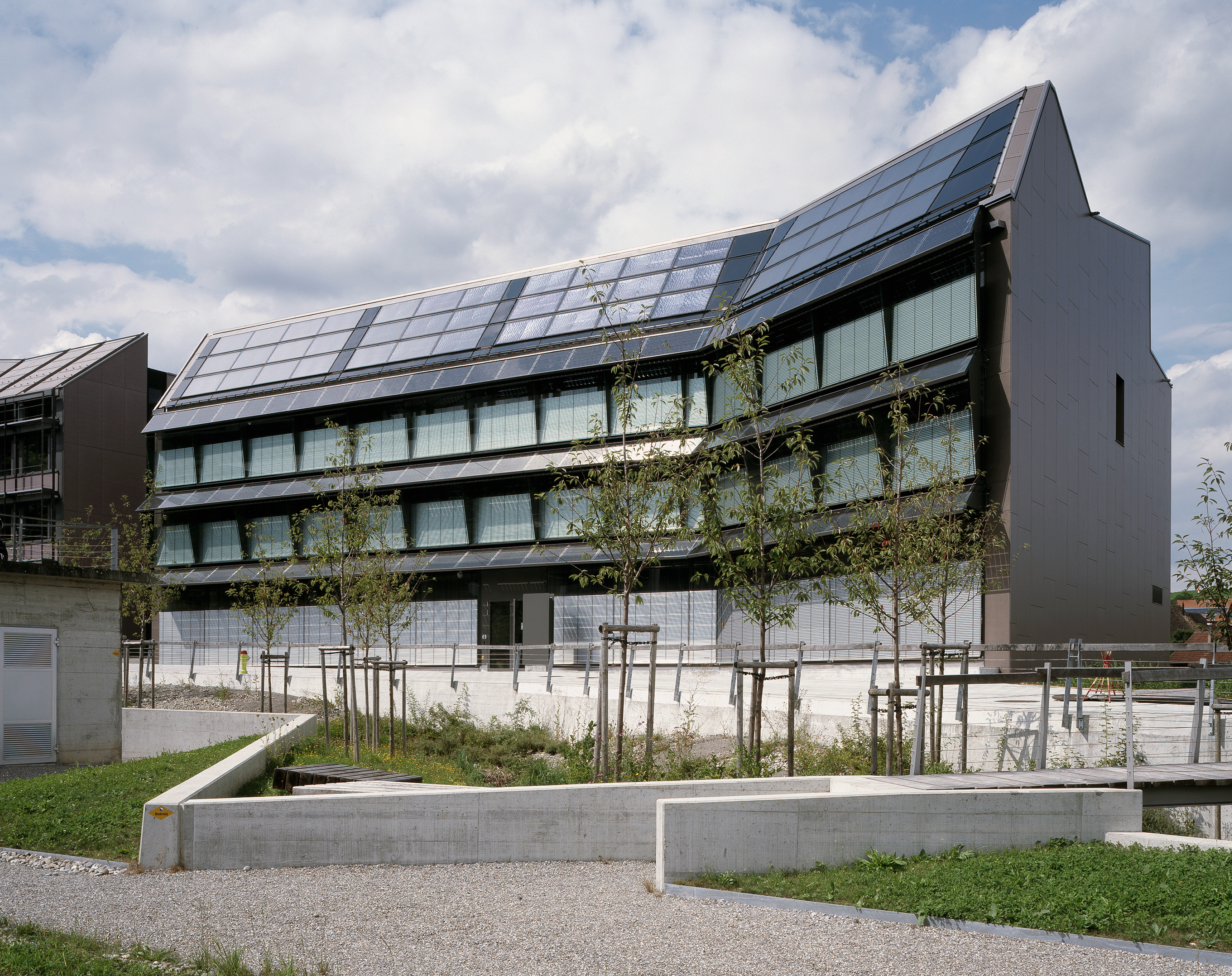
Alexandre: Basler & Hofmann is a founding member of the NNBS. We have also already supported numerous clients in the certification process for "SNBS structural engineering". It was therefore clear to us that we also wanted to contribute our sustainability expertise to the certification of existing properties. Together with Rehalp Verwaltungs AG, we had the opportunity to test the applicability, informative value and benefits of the new "SNBS Existing Buildings and Operations" standard for ecologically sustainable real estate development at one of our three commercial buildings in Esslingen as part of a pilot phase for the NNBS in 2025.
Our commercial building in Esslingen received a score of 4.2 out of 6 as a pilot property.What does this mean in concrete terms for the owner?
Alexandre : The commercial building was put into operation in 2010 as an almost energy self-sufficient office building with Minergie-P-Eco certification. It has a solar thermal system, building-integrated photovoltaics, an underground storage tank and uses the server cooling system to generate heat. Great importance was attached to ecological sustainability during the planning and construction phases. This is reflected in the "SNBS Construction and Operation" assessment after 15 years of operation. The evaluation process has shown that the building is still performing well in many sustainability aspects even after 15 years. The fact that the final score is not higher is due to the fact that new sustainability aspects have been added in the last 15 years. Fifteen years ago, the focus in the construction and operation of real estates was primarily on energy efficiency and renewable energy. The example shows: Sustainability is not a static concept, but is constantly evolving. The assessment according to "SNBS Portfolio and Operation" now offers the owner an objective basis for the further development of the real estate.
With "Stratus", Basler & Hofmann has software for professional real estate portfolio management on the market. The software is used by numerous real estate managers in Switzerland.Do you see synergies between the condition evaluation according to Stratus and the evaluation according to "SNBS Portfolio and Operation"?
Alexandre: Absolutely. In Stratus real estate managers can record important key figures on the structural and energy-related condition of their properties. If they want to be certified according to "SNBS Portfolio and Operation", they already have a broad data basis, which makes the assessment process for the standard very efficient. Those who work with Stratus have additional advantages to the SNBS assessment. In addition to recording the current sustainability status, the software also offers the option of combining measures recommended by the SNBS with financial aspects. This makes it possible to create an investment plan that optimally combines value preservation and sustainability.
Press release from the NNBS dated April 9, 2026: SNBS closes the gap
* Federal Office of Energy, 09.04.2026: Buildings

![[English] Holzbau Hybridbau](/fileadmin/_processed_/b/a/csm_0_Header20260507_Bau_Holz_3OG_gerade_ec0957440e.jpg)
