
Owner's Liability: How to Prevent Risks


Who is liable and who pays when someone or something is damaged due to a defect in a structure? For real estate professionals managing large property portfolios, liability of the owner of a structure (Art. 58 OR) represents a significant liability risk. At the Stratus-Convent 2026, they learned how to mitigate risks and ensure safety within and around their buildings.
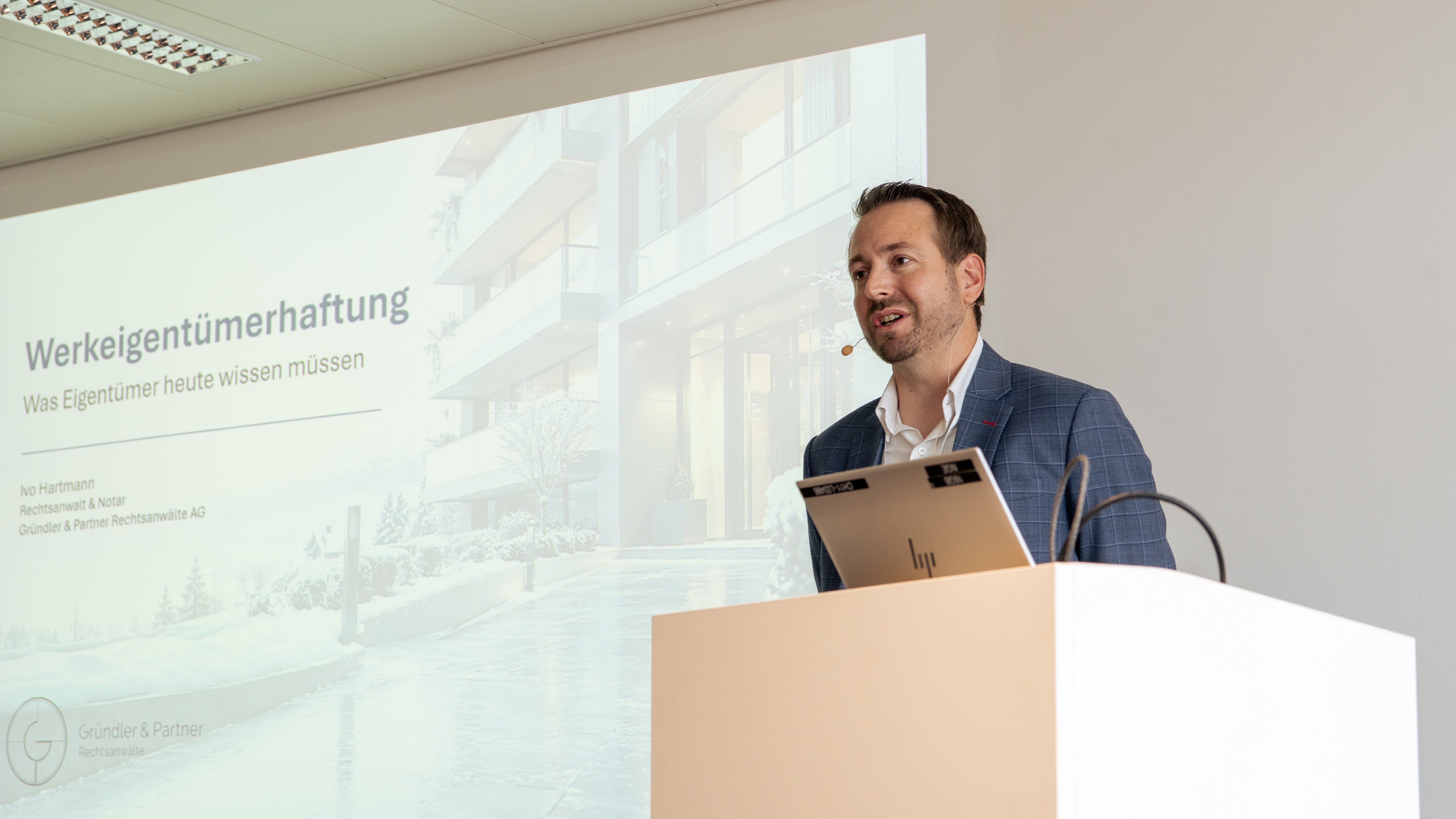
Imagine this: someone slips on ice in front of your property and breaks a leg. Who is liable? Is it the caretaker who failed to clear the snow? The property management firm you have commissioned? Or the architect who designed the entrance area? "In all these cases, the owner is liable," says Ivo Hartmann, a lawyer specializing in administrative, construction, and planning law in St. Gallen.
Hartmann adds: "The owner is liable, even if they did not cause the damage themselves." At most, they can seek recourse against the responsible party in a secondary step. Consequently, real estate professionals carry a heavy burden of responsibility. This raises a pressing question: How can someone responsible not just for a single building, but for an entire real estate portfolio, maintain oversight and ensure safety?
Ensuring the safety of buildings and premises
"Rest assured," Ivo Hartmann remarked at the Stratus-Convent 2026, the annual gathering for those responsible for real estate portfolios. At the invitation of Stratus, approximately 100 participants came together in late October to exchange ideas. The topic: liability of the owner of a structure. "The law only requires property owners to maintain a condition that allows for safe, intended use," Hartmann clarified during the conference. Using case studies, he explained how real estate professionals can ensure this state of safety.
What constitutes a “structure” for the purposes of owner liability?
In Switzerland, the liability of the owner of a structure is governed by Article 58 of the Code of Obligations (Art. 58 OR). A "structure" can be many things: a staircase, a balcony, a façade, a swimming pool, or a playground. Legally, any installation qualifies as a structure if it was artificially created by human hands and is permanently attached to the ground.
Who is the “owner of a structure”—and who is liable?
The "owner of a structure" is defined as the owner of the installation, the owner of the land, or the holder of a building right—but not the tenants or the users. The owner of a structure can also be a municipality that owns buildings, such as a maintenance depot or a schoolhouse. If a structure has a defect that leads to damage, the law is clear: liability rests with whoever owns the structure. "An owner cannot talk their way out of it when a defect in a building causes someone to be injured," Ivo Hartmann clarified. "Strict liability applies."
Prevention is key, but not against every conceivable risk
For this reason, property owners and real estate professionals must take preventive measures. The good news is: the law does not require them to prevent every conceivable danger, but only those risks arising from the nature of the structure and its normal use. Therefore, owners "only" need to ensure that the structure provides sufficient safety when used as intended.
As an example, Hartmann cited the "balcony railing case": A tenant was smoking on his balcony; during this, he sat on a low balcony railing that was only 80 centimeters high and fell to his death. The Federal Supreme Court ruled that, in this instance, the building owner was not liable. The reason: The man had used the low railing "improperly"—the railing was never intended to be used as a seat. The practical implication is this: "As an owner, you do not have to secure your structure against improper use," says Hartmann.
When is a building or structure considered safe?
When can an owner assume that their structure is considered safe? Standards serve as an indicator. Naturally, laws designed to prevent accidents must also be complied with. However, "reasonableness" also plays a role, as the legal expert noted.
"As a real estate professional, you cannot be expected to do the impossible," Hartmann stated at the Stratus-Convent, before explaining how reasonableness is legally defined. Key factors include the probability of damage occurring, the effectiveness of a measure—and its costs.
Hartmann made one thing clear: a lack of funds cannot be used as an argument to evade responsibility. If there is insufficient money to maintain an installation safely, the owner must decommission, cordone off, or dismantle the structure.
Warning signs are not enough
Is it sufficient to put up a warning sign when a danger is imminent? For example, "Caution: Black Ice"? Not necessarily. "That is a one-sided declaration, and as such, it is not worth much," Hartmann explained. Citing a court case (ZKBER.2019.27 of August 13, 2019), he made it clear that it is wiser to take an additional reasonable measure, such as "spreading road salt"—in other words, effectively remedying the defect.

How property owners can prevent liability risks
"You do not need to create a completely risk-free zone," Hartmann clarified. However, it is always worth asking: Have I demonstrably done everything reasonable to ensure the safe condition of my properties and structures? To mitigate liability risks, defects should be remedied as quickly as possible. To this end, Hartmann advised real estate professionals to:
- Regularly inspect your properties and structures for safety risks, especially following changes to standards or legislation.
- Document and prioritize the defects identified during inspections. Criteria for prioritization include, among others, the user group (private or public use?), the potential for damage, the frequency of accidents, the cost of remediation, and required immediate measures.
- Whenever it is reasonable to do so: Remedy the defects.
As Hartmann concluded, the most effective strategy is the following: "For owners, the best prevention strategy is to conduct periodic inspections of their properties and surroundings, identify and document defects, remedy them, and, if necessary, put up warning signs."
Building safety requires a holistic strategy
Gianluca De Sanctis, Team Leader of Safety Consulting at Basler & Hofmann, addressed this concept in his presentation: "Is my building safe? Everyone who owns property should ask themselves this question regularly," he emphasized.
His understanding of safety extends far beyond merely avoiding liability risks. Companies or property owners with large portfolios, in particular, must define and address both strategic and operational goals. De Sanctis provided an example: if a company's primary production facility burns down, it can threaten the very existence of the business.
As a solution for a holistic risk strategy—one that identifies all relevant risks, from fires and earthquakes to operational safety—he presented the concept of "Integrated Security" and demonstrated how Basler & Hofmann develops such comprehensive security strategies for its clients.

Practical Dialogues at the Stratus-Convent
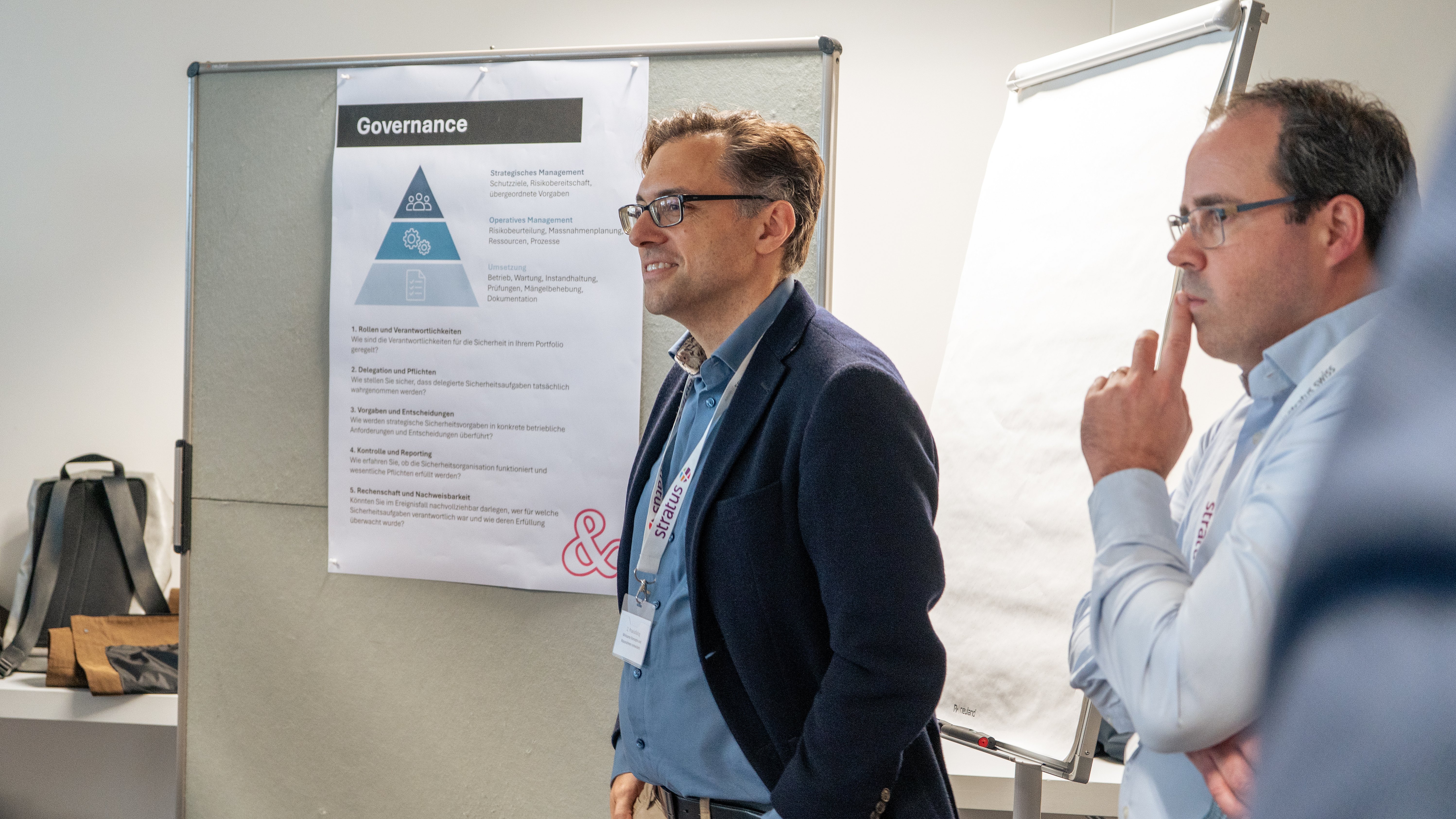
Following the presentations by Erol Doguoglu, Cantonal Construction Manager of St. Gallen, Ivo Hartmann, and Gianluca de Sanctis, the Stratus-Convent moved into a phase of professional exchange. During practical dialogues, participants delved deeper into topics such as risk screening, security concepts, mitigation measures, enforcement, and documentation. Safety and security specialists from Basler & Hofmann, including Yves Mondet, Christoph Rüedlinger, and Tim Stockheimer, along with real estate experts such as Friederike Pfromm, Bianca Brici, and Anna-Lena Burren, moderated these discussions.
Stratus Software: Managing Real Estate Risks with "Controls"
The Stratus team from Basler & Hofmann is the force behind the annual Stratus-Convent. Stratus is a methodology and software solution designed for professional real estate portfolio management. With its new "Controls" feature, Stratus now provides real estate professionals with a tool to monitor and manage safety-related aspects within their property portfolios. This software feature informs managers of what must be inspected, when, by whom, and based on which regulation—helping them to systematically identify risks, manage measures, and provide transparent proof of compliance with legal inspection duties.
Want to learn more? Visit the Stratus website and explore our services


