
Safety and Security for a Historic Landmark: Fire Engineering at Zurich's Grossmünster



How can a historic building be protected from fire without unduly interfering with the cultural heritage site and its use? The Grossmünster in Zurich is currently undergoing renovation. Basler & Hofmann is responsible for the fire protection planning. The challenge is to balance multiple priorities simultaneously: personal safety, the protection of the historic existing structure, visitor operations, and a large-scale construction site. Our experts base their approach on the specific risks involved.
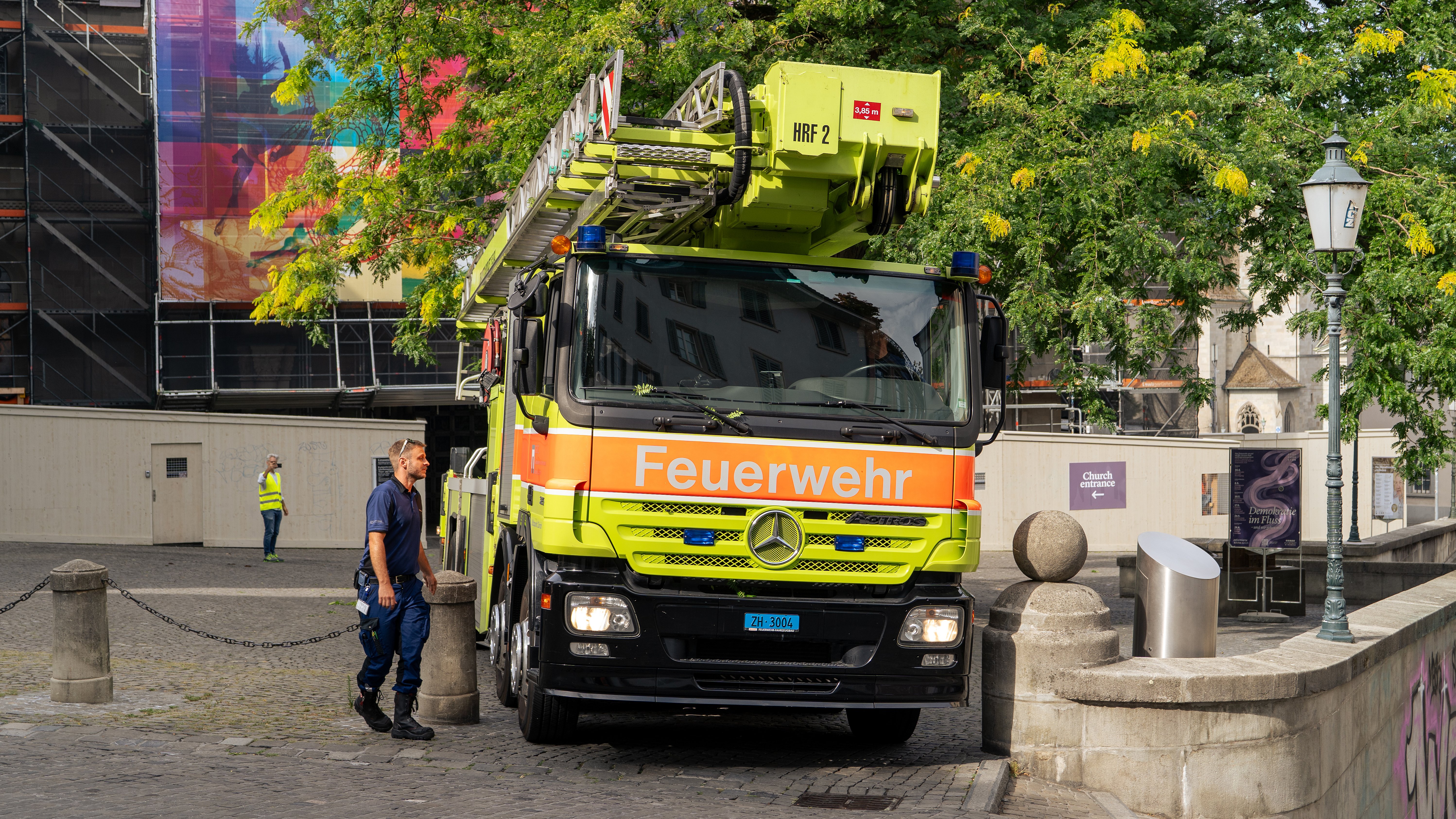
The driver of the fire engine is maneuvering with millimeter precision. He glances in the rearview mirror one last time and backs up. Will he manage to drive his emergency vehicle through the narrow gap between the stone bollards all the way to the Grossmünster? A little more maneuvering – and he succeeds: The vehicle from Kloten reaches the Grossmünster on Zwingliplatz in Zurich. The ladder is extended. At 53 meters, it is the longest fire ladder in the canton.
On-site Test of Rescue Capabilities in the Event of a Fire
On this morning in July 2026, a “driving and ladder deployment test” is taking place at the Grossmünster. The professionals on site – representatives from the fire department and fire police, the cantonal Department of Public Works, the parish, and the fire safety experts from Basler & Hofmann – are eager to find out: Is the fire department’s longest ladder long enough to reach the towers of the Grossmünster in the event of an emergency?
Jakob Studhalter, a fire safety expert at Basler & Hofmann, climbs into the ladder’s rescue basket along with three other specialists. The basket rises upward. Once the 53-meter-long ladder is fully extended, it reaches the railing of the visitor platform. Rescuing people would therefore be possible – but time-consuming. Valuable time is lost by the time the fire truck from Kloten drives here and maneuvers through the narrow access road.
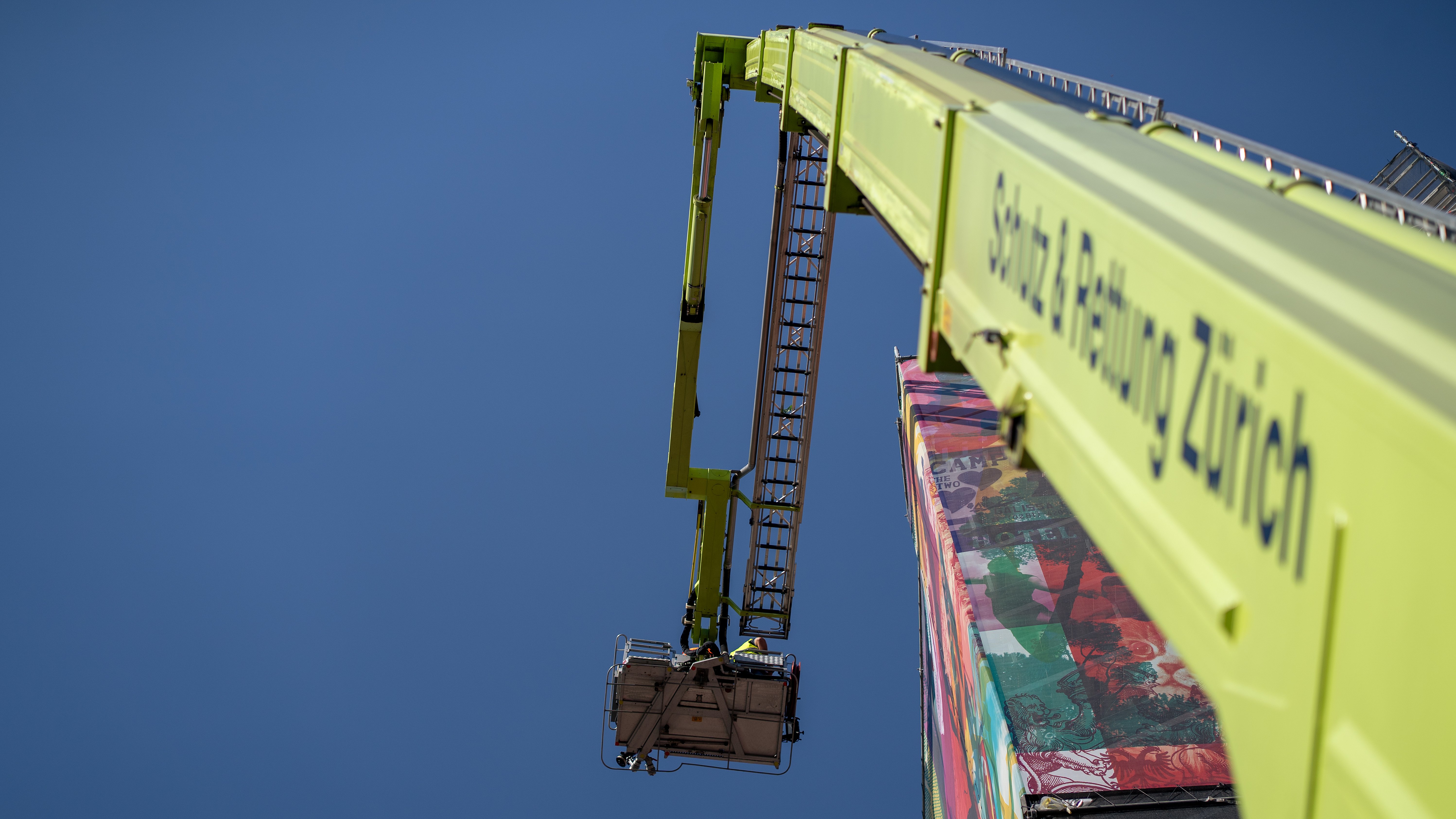
The test provides an important insight for fire engineering planning: Rescue via a fire department ladder generally works, but it may not be available quickly enough. Therefore, additional fire engineering measures are needed.
Redevelopment Featuring an Art Installation at the Grossmünster
Zurich’s Grossmünster is undergoing extensive renovation through 2028 . This historic monument, which is over 900 years old, is restored approximately every 50 - 100 years. Basler & Hofmann is responsible for fire safety planning on behalf of the cantonal building authority.
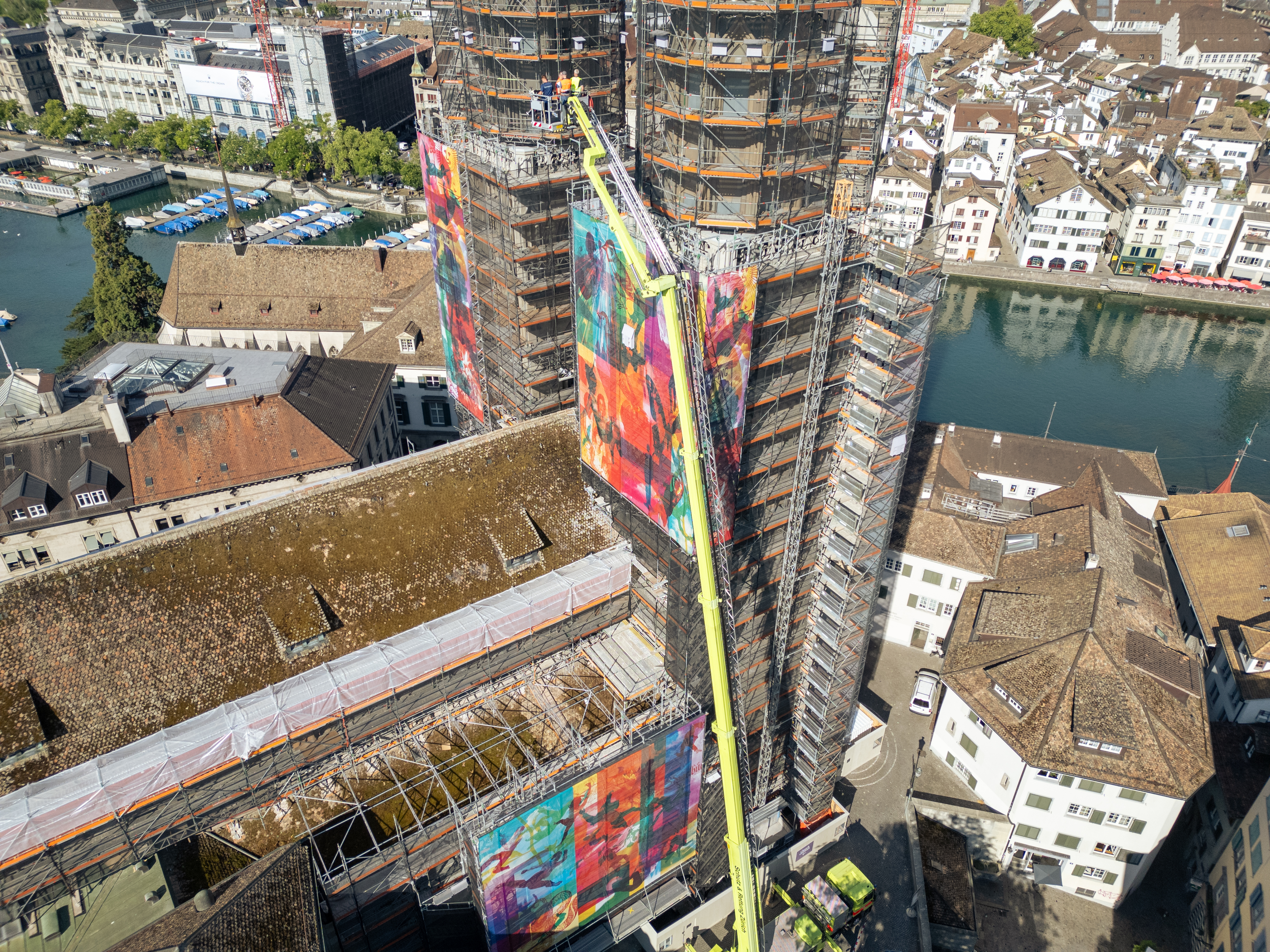
When developing the fire protection concept, Jakob Studhalter and his team initially focused on the interior spaces. But then it became clear that artwork would be installed on the scaffolding during the facade redevelopment. The artist Shirana Shahbazi was commissioned to decorate the scaffolding netting with photo collages. As a result, the exterior construction site became a greater focus for the fire safety experts.
To minimize the fire risk at the facade construction site, they developed a specific “Fire Engineering Concept During Construction” on behalf of the building owner. Among other things, this ensured that the artist used only flame-retardant materials for the scaffolding covering.
Fire Engineering for a Highly Visited Cultural Heritage Site
The Grossmünster in Zurich is no ordinary construction site. The building is 64 meters high, heavily visited, and, as a historic monument, particularly worthy of protection. The Grossmünster thus places high demands on fire engineering:
- As a historic monument, it is a special asset whose construction does not comply with current fire safety standards. Any work or installations must be carried out as carefully as possible and in accordance with the requirements of historic preservation.
- Our experts identified the greatest fire risk in the roof truss and the towers: The roof truss consists of wooden beams up to 800 years old and spans an area of approximately 1,500 m² – a fire could quickly spread over a large area. The tower staircases are also made of wood, and the Karlsturm features a high-altitude visitor terrace that is visited by dozens of guests every day.
- The church is being renovated during an ongoing operation: It will stay open to the public: churchgoers and tourists will be able to visit during the construction phase.
- Large events with over 1,000 guests should still be able to be held safely in the nave in the future.
- The visitor experience in the church should be disrupted as little as possible by fire safety measures. This argues against, for example, permanently illuminated emergency exit signs.

Fire engineering can help protect historic buildings
For Jakob Studhalter and his team, this means they must develop a fire protection concept that reconciles conflicting objectives.
Matthias Wegmann, senior fire engineering expert at Basler & Hofmann, describes the challenge as follows: “The current fire engineering regulations are designed for standard buildings; they are geared toward protecting people and buildings, not toward historic preservation. This can lead to conflicting objectives, especially between personal safety and historic preservation.” A measure that only slightly increases personal safety should not, at the same time, significantly alter the historic structure. Conversely, the protection of the historic fabric must not result in real fire risks being ignored.
“In historic buildings, the conditions for fire engineering are often not that bad,” explains Jakob Studhalter. While the buildings may not meet current standards, that does not mean they are inherently less safe.
The key is to recognize the opportunities and risks of the existing structure. “Fire engineering can also be historic preservation,” Jakob is convinced. Matthias adds: “For us, effective fire engineering is more than just compliance with fire safety regulations. We understand it literally as protection against fires, based on the actual risks on site.”
Large roof trusses can pose a risk
Current fire safety regulations, for example, do not impose any requirements on roof structures. At the Grossmünster, however, the roof truss poses significant fire risks: Due to the size of the attic and its difficult accessibility, a fire would be difficult for the fire department to extinguish.
The devastating impact a fire in a large roof truss can have was brought home to the world not least by the major fire at Notre-Dame Cathedral in Paris in 2019. In the case of the Grossmünster, our experts therefore recommended the installation of an automatic fire suppression system that would detect and combat a fire in the roof truss as soon as it starts. Upon an alarm, it would automatically spray water into the roof and towers. This helps prevent a fire from escalating into a major blaze.
Challenges in Existing Buildings: Escape Routes
Escape routes are a common challenge in historic buildings. Due to their historical construction, staircases, for example, are too narrow to qualify as escape routes under current fire safety standards. This is also the case at Zurich’s Grossmünster. However, for reasons of historic preservation, the staircases there cannot simply be widened.
“We’re developing a concept that works with the existing staircases to ensure a safe escape in the event of a fire,” explains Jakob. The concept also includes organizational measures, such as evacuation assistants who are on duty during large events. In addition, the fire engineering plan takes advantage of the ceiling height in the nave: Since the space is very high, the smoke layer forms far up, allowing enough time to evacuate people safely.
Safety Audit at the Construction Site
The automatic fire suppression system and evacuation procedures mentioned above are intended for the normal operation of the renovated church. During the construction phase, additional precautions are necessary, as the risk of fire is particularly high on construction sites (see expert interview).
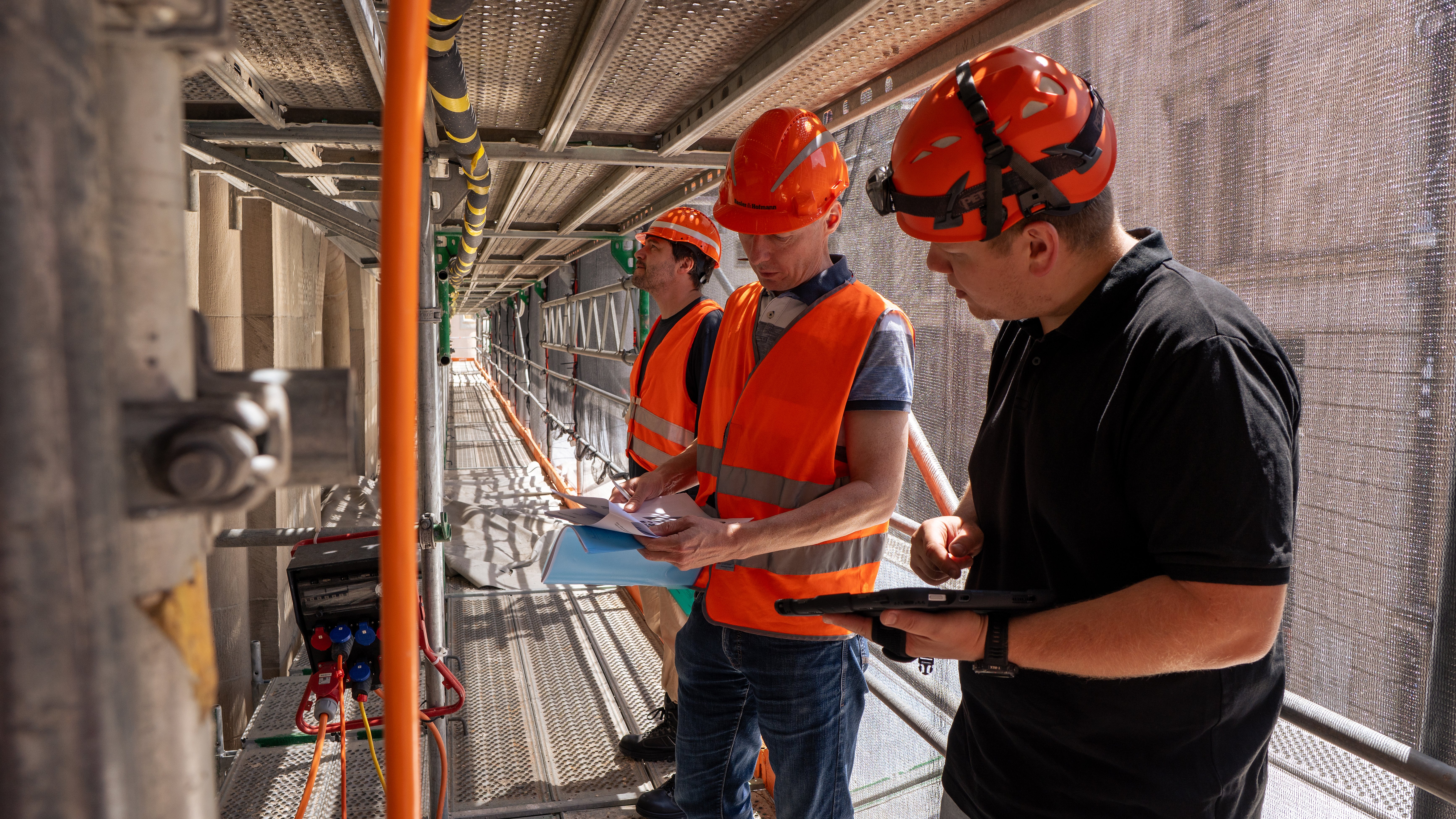
To verify that the measures outlined in the construction site fire safety plan are actually being implemented, Jakob returns to the scaffolding at the Grossmünster a few days after the fire department’s test. He meets with the site manager in charge, Fabian Hunziker of Martini Schäfer Baumanagement, for a walkthrough. With the fire safety plan in hand, Jakob checks, among other things: Is there any material lying around that could catch fire? Are the escape routes clear, even on the scaffolding? Are hot work operations – such as welding – carried out during designated time windows and with fire watchers present?
The two ride the construction elevator up along the facade of the Grossmünster. Up near a tower dome, there’s a smell of fresh paint.
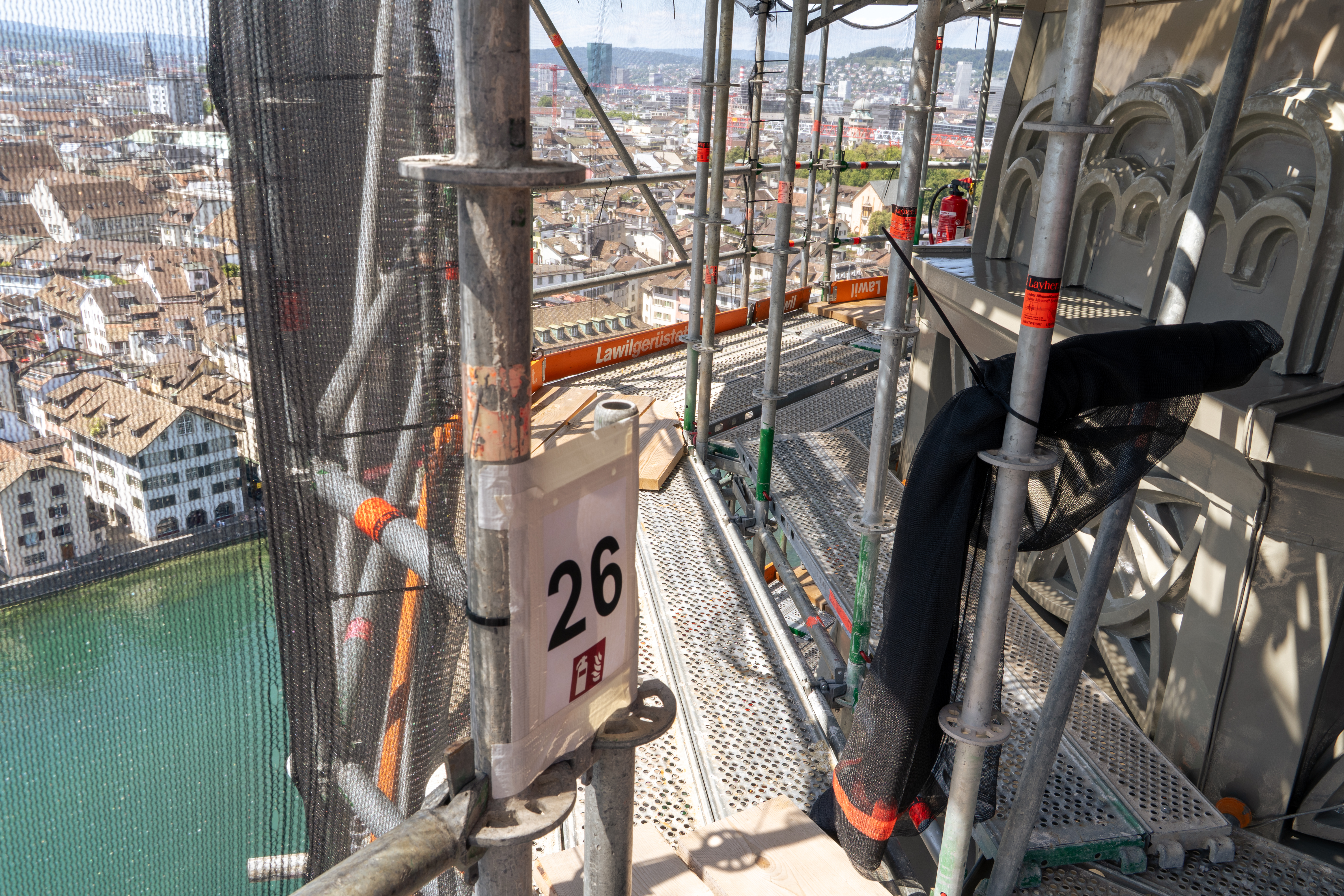
A painter is at work. Jakob walks over to him and asks, “Where do you keep your paint supply?” The painter replies, “We only take what we need up onto the scaffolding.” This is a good practice for fire safety, since paints and varnishes can be highly flammable. Jakob asks further, “Do you know where the nearest fire extinguisher is?” The painter knows that, too. Another positive observation: Signs on the scaffolding levels indicate where fire extinguishers and electrical distribution panels are located. Electrical equipment is a risk factor, which is why Jakob also inspects these devices closely.
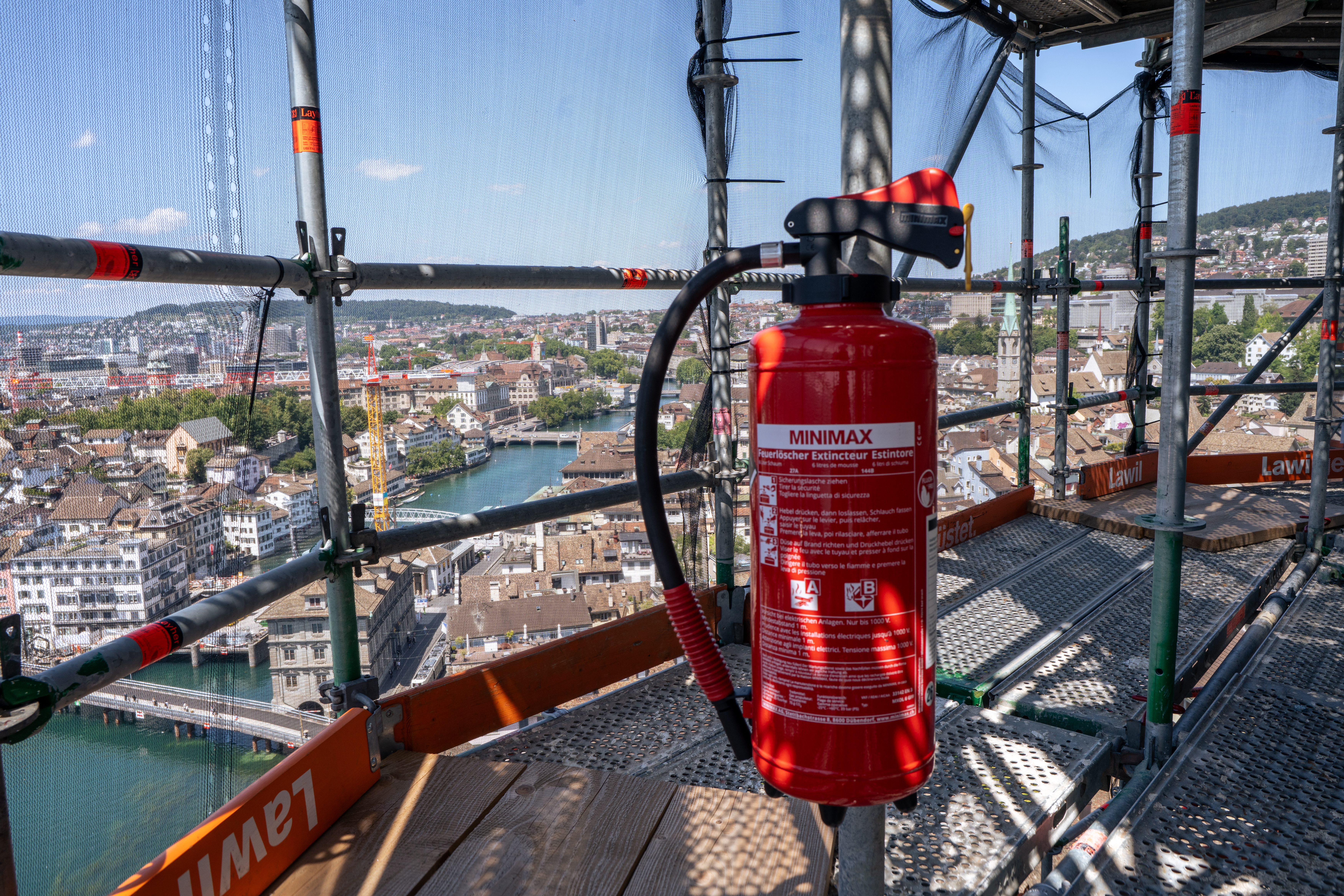
“When it comes to fire safety, a great deal can often be achieved with very little effort,” says Jakob Studhalter. Organisational measures, such as placing fire extinguishers in key locations or putting up a notice with emergency numbers, often make a big difference.
An hour later, Jakob has finished his audit at the Grossmünster. He praises the site manager: “We found everything to be in exemplary order here.” The construction workers, including the carpentry crew and the team leading visitor tours, are well informed. The activation and deactivation of the fire alarm system are properly documented. The only place Jakob was unable to inspect that day was the carpenters’ workshop, because no one was working there. Jakob will make up for this quality control check during his next site visit.
Standard solutions fall short
The Grossmünster illustrates what fire engineering means for a historic building: standard solutions fall short. What’s needed are experts who understand the building and its use, realistically assess risks, and develop effective solutions in collaboration with the building owner, site supervision, authorities, and other stakeholders. In this way, fire engineering safeguards not only people, but also a structure that has been part of Zurich’s history since the Middle Ages.
More on fire engineering and historic preservation: Feature article “Think About Fire Engineering!” (in German), Source: SSI Magazine 2025, p. 10 ff.
On fire safety at construction sites: Expert interview with Matthias Wegmann and Jakob Studhalter


